The Burnt Hands Under the Ragged Sleeve Made the Billionaire Drop to His Knees
The air was ice. Alejandro’s pulse throbbed against his silk collar. The velvet rope felt like a border between gods and ghosts. He didn’t look at the dirt. He smelled the expensive cologne. He felt the weight of his own power. Then the shadow moved. A hand reached out. It was gnarled. It was burnt. The world turned cold in a single heartbeat.
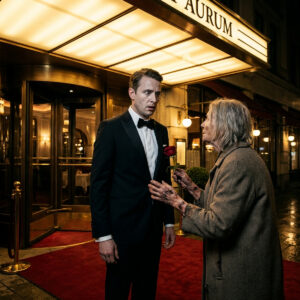
The evening air in the capital was thick with the scent of high-octane exhaust and the lingering aroma of truffles drifting from the ventilation systems of the Grand Azure. To the uninitiated, the entrance to the restaurant was a spectacle of light and sound; to Alejandro Ferrer, it was merely his backyard. The golden floodlights bathed the red carpet in a hue that mimicked the sun, casting long, sharp shadows that danced between the legs of the men in tuxedoes and the women in gowns that cost more than a suburban home. Alejandro stepped from the rear of his charcoal-black sedan, his leather soles meeting the pavement with a rhythmic, percussive click. It was the sound of ownership. Every camera lens in the vicinity pivoted toward him like a synchronized battery of artillery. He didn’t smile. He didn’t have to. His success was a shield, and his indifference was his sword.
Inside his mind, Alejandro was already three hours ahead, calculating the merger that would define his next decade. He felt the starch of his white shirt against his ribs, a reminder of the rigid order he imposed on his world. He moved with a predatory grace, his eyes fixed on the revolving glass doors that promised sanctuary from the noise of the common street. The guards, giants in charcoal suits, performed a choreographed bow. They knew the man. They knew the empire. To them, Alejandro was not just a guest; he was the gravity that kept the building centered. The atmosphere was a pressurized chamber of vanity and ambition, where the clinking of champagne flutes acted as a heartbeat. Alejandro inhaled the sterile, expensive air, oblivious to the world that existed beyond the reach of the golden spotlights.
But the city always has a way of bleeding into the light. At the periphery of the red carpet, where the shadows of the stone pillars met the sidewalk, a presence began to manifest. It was a shape that didn’t belong in the geometry of the elite. Alejandro felt a flicker of irritation—a micro-expression that tightened the corner of his left eye. He was a man who demanded symmetry. Anything that disrupted the aesthetic of his evening was a nuisance to be erased. He didn’t yet realize that the woman standing in the darkness was about to dismantle the very foundation of his identity. He only saw a smudge on his perfect evening, a distraction that smelled of the damp street and the cold reality he worked so hard to ignore.
The woman stepped forward with a slow, deliberate hesitancy. Her clothing was a collage of faded greys and frayed threads, a stark contrast to the shimmering silk that surrounded her. Her shoes were worn to the soles, the leather cracked like the dry earth of a desert. In her hand, she held a single flower—a carnation that looked as tired as she did. Alejandro stopped. The movement was so abrupt that the guests behind him nearly collided with his back. The silence that followed was not empty; it was a heavy, expectant void. The guards tensed, their hands hovering near their belts, their eyes scanning the woman for a threat that wasn’t there. Alejandro’s gaze was a cold, clinical laser. He looked at her not as a human being, but as a technical error in his program.
“Señor… please, buy a flower,” she whispered. The voice was thin, like parchment being folded, yet it carried an underlying strength that refused to be drowned out by the hum of idling engines. Alejandro’s jaw tightened. He could feel the eyes of the city’s power brokers on him. He felt the cameras recording his reaction. To him, this was a test of his authority. If he allowed the perimeter to be breached by a beggar, he was vulnerable. He looked at the flower, then at the woman’s unwashed hair, and finally at the guards. “Sáquenla de aquí,” he said. The words were a low growl, devoid of empathy, designed to end the interaction before it could stain his reputation. Get her out of here.
The guards moved in. Their boots made a heavy, dragging sound on the carpet as they converged on the small, fragile figure. A few of the guests near the entrance turned their heads, their faces twisted into masks of practiced disdain. They saw the woman as a symptom of a world they had successfully escaped. They wanted her gone so they could return to their caviar and their lies. The woman didn’t flinch. She didn’t retreat into the shadows from which she had emerged. Instead, she stood her ground, her eyes locking onto Alejandro’s with a terrifying, ancient familiarity. She looked through the billionaire, past the charcoal suit and the ego, and into the child that still lived beneath the surface of his skin.
“Sigues teniendo los ojos… del niño del incendio.” You still have the eyes… of the boy from the fire. The sentence didn’t just hang in the air; it vibrated through Alejandro’s skeletal structure. The world around him began to blur. The golden lights of the Grand Azure seemed to stretch into streaks of orange and red. The scent of truffles was replaced by a sudden, violent memory of woodsmoke and melting plastic. Alejandro’s breath caught in his throat, a sharp, jagged intake of air that felt like he had inhaled ash. He turned his head slowly, his neck muscles straining against his collar. The arrogance that had defined his posture for forty years vanished, replaced by a raw, primitive confusion.
He looked at her again. Truly looked at her. He saw the map of wrinkles on her face, the way her skin draped over her cheekbones like a tired shroud. But it was her hands that anchored him to the moment. As she reached out to offer the flower one last time, the frayed sleeve of her coat slipped back. There, illuminated by the harsh white light of a photographer’s flash, were the scars. They were not modern surgical marks, but deep, thick ridges of keloid tissue that snaked across her palms and up her wrists. They were the marks of a battle with an elemental force. They were the signatures of the fire that had defined his early years.
Alejandro felt a cold sweat break out along his hairline. His mind raced back thirty years, to a house that no longer existed. He felt the heat on his shins. He heard the roar of the ceiling collapsing. He remembered the feeling of the oxygen being sucked out of the room, leaving him gasping for a mother who couldn’t hear him. And he remembered the arms. Not the soft, familiar arms of his family, but the strong, desperate arms of a stranger who had reached through the wall of flame to find him. He had spent his entire life looking for the owner of those arms, building a kingdom so he would never be small or trapped again, only to order her removal from his sight at the moment of their meeting.
Memory is not a video; it is a visceral, sensory experience. Alejandro wasn’t standing on a red carpet anymore. He was six years old, trapped behind a heavy oak door that had expanded in the heat. The smoke was a black liquid, filling his lungs and blurring his vision. He remembered the sound of the glass shattering—not the delicate clink of a wine glass, but the explosive roar of a window yielding to the pressure. He remembered the silhouette that appeared in the orange glow. It was a woman. She didn’t scream. She didn’t hesitate. She threw a wet blanket over him and lifted him with a strength that defied her size. He remembered the feeling of her skin burning as she carried him through the hallway of embers.
The woman in front of him now carried that same silhouette. The way she tilted her head was the same way she had tilted it that night to protect him from the falling debris. The scars on her hands weren’t just injuries; they were the physical price she had paid for his existence. She had entered a furnace to save a child who wasn’t hers, and she had disappeared into the night before the sirens arrived, leaving behind a boy who would grow up to be a man of ice. Alejandro felt a wave of nausea. The psychological weight of his own cruelty toward her seconds before was a crushing blow. He had become the very thing the fire tried to destroy: a cold, unfeeling force.
“Te saqué por la ventana… mientras todos corrían,” she said softly. I took you out through the window… while everyone else was running. The guards had stopped. They looked at each other, then at their boss, sensing the seismic shift in the atmosphere. The guests were frozen in various states of social performance—one woman with her hand over her mouth, a man with a half-raised glass of scotch. Alejandro’s eyes filled with a stinging, hot moisture. He took a step back, his legs feeling like they were made of water. The billionaire was gone. The titan of industry was dead. There was only the boy, finally seeing the face of his guardian angel in the most unlikely of places.
Alejandro didn’t just sit; he collapsed. His knees hit the red carpet with a sound that felt final. The billionaire, the man whose face graced the covers of magazines, was kneeling in the dirt at the feet of a woman the world had discarded. The cameras, which had been hunting for a glamour shot, now captured the image of a god falling from his throne. Alejandro didn’t care. He reached out and took the woman’s scarred hands in his own, his fingers tracing the ridges of the burnt tissue. His tears fell onto the carpet, dark spots appearing on the crimson fabric. “Fuiste tú…?” he whispered, his voice a ragged sob. Was it you?
The woman nodded, a slow, graceful movement that carried a dignity the other guests would never understand. She didn’t ask for money. She didn’t demand recognition. She had spent thirty years in the shadows, living a life of quiet hardship, while the boy she saved built a fortress of gold. She had worked as a cleaner, a street vendor, a ghost in the machinery of the city. She had seen his face on billboards and had smiled to herself, knowing that the child lived. She hadn’t come to the restaurant to claim a reward; she had come to see the eyes of the boy one last time before her own sight failed.
The spatial tension of the red carpet had changed. The guests were no longer the audience; they were the intruders. The restaurant, with its golden lights and its pretension, seemed small and garish compared to the raw reality unfolding on the sidewalk. A waiter nearby dropped his tray, the sound of breaking porcelain punctuating the silence like a gunshot. No one moved to help him. All eyes were fixed on the man who had everything, holding the hands of the woman who had nothing, yet had given him his entire existence. The internal monologue of the crowd was a mixture of shock, shame, and a sudden, uncomfortable awareness of their own shallowness.
Alejandro stood up, but he didn’t let go of her hands. He looked at the guards, his eyes red and fierce with a new kind of power—the power of a man who had finally found his soul. “No vuelves a dormir en la calle nunca más,” he said. You are never sleeping on the street again. The words were not a promise; they were a decree. He took the single flower from her hand, holding it as if it were a holy relic. The irony was not lost on him; he had spent millions on art and real estate, but the most valuable thing he had ever held was a bruised carnation from a woman he had tried to exile.
He turned toward the restaurant, but he didn’t enter alone. He tucked the woman’s arm into his, guiding her toward the golden doors. The guards stepped back, bowing deeper than they ever had for a politician or a movie star. This was a different kind of royalty. As they passed the guests, the silence remained absolute. The elite of the city watched as a woman in rags and a man in a thousand-dollar suit walked together into a world of luxury. Alejandro didn’t look at his friends or his associates. He didn’t look at the cameras. He looked only at the woman beside him, his mind already planning the life he would provide for her—a life of comfort, of medical care, and of the respect she had earned with her blood and skin.
The psychological atmosphere of the Grand Azure had been permanently altered. The luxury that had seemed so vital moments ago now felt like a thin veneer. The guests would return to their meals, but the flavor of the evening had changed. They had witnessed a moment of genuine humanity that made their own lives look like stage plays. Alejandro had learned that the largest debt a person can carry is not one of money, but one of existence. He had been a man who believed everything could be bought, until he met the woman who had given him the world for free.
Inside the restaurant, the music continued to play, but Alejandro led the woman to the center table—the one reserved for the most important guest of the night. He sat her down, oblivious to the whispers and the stares. He ordered the finest meal, the softest water, the most attentive service. He sat across from her, his eyes never leaving hers. He realized that for thirty years, he had been running away from the fire, building walls to keep out the heat, but he had also kept out the warmth. This woman was the fire’s opposite. She was the light that didn’t burn.
As the night progressed, the story of the businessman and the flower seller began to ripple through the city. It wasn’t a story of charity; it was a story of a debt being recognized. Alejandro had spent his life accumulating things, but in one hour on a red carpet, he had found the only thing that actually belonged to him: his history. He saw the woman eat, her scarred hands moving with a grace that transcended her circumstances. He realized that true power wasn’t the ability to make people move; it was the ability to recognize who had moved the world for you when you were too small to do it yourself.
The golden lights of the Grand Azure continued to shine, but for Alejandro Ferrer, the glow was different now. It didn’t come from the chandeliers or the spotlights. It came from the tired, scarred woman sitting across from him. He had ordered an old woman out—and in doing so, he had almost discarded his own soul. But fate had intervened, allowing the boy from the fire to finally thank the woman who had carried him through the flames. The gratitude he felt was a weight, heavier than gold, but it was a weight that finally made him feel grounded. He wasn’t just a powerful man anymore; he was a saved man.
Disclaimer : This content may be created by AI for entertainment purposes. Any resemblance to real persons, events, or places is coincidental.