Her Father Sold Her When She Couldn’t Have Children—Until A Cold Mafia Boss With 3 Broken Kids Taught Her What Family Really Means.
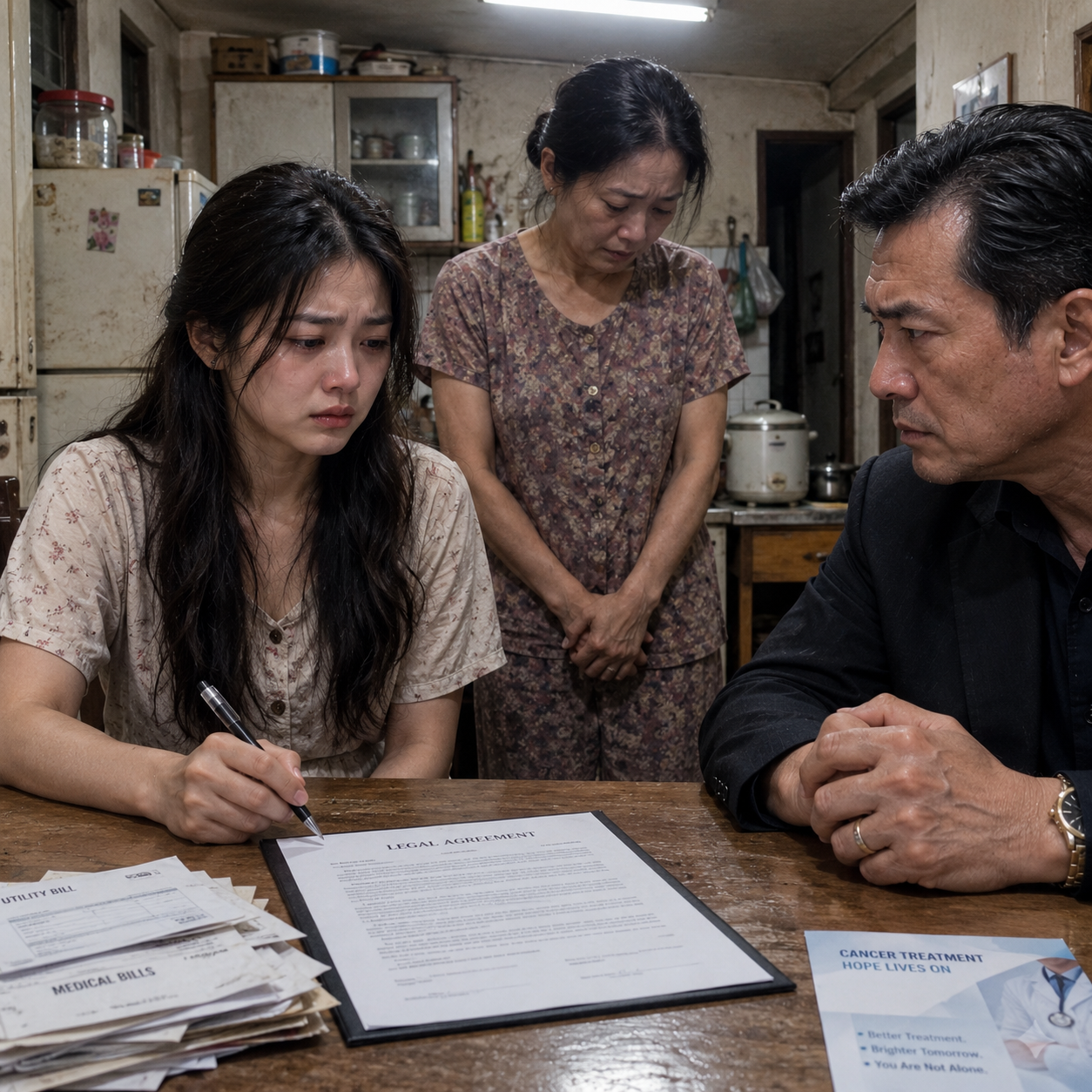
Chapter 1: The Diagnosis
The doctor’s voice was calm. That was the worst part.
Not cruel, not gentle, just calm. The way someone reads a grocery list or checks the weather.
He folded his hands on the desk and told Lily Marsh that she would never carry a child to term.
Then he handed her a pamphlet about alternative paths to parenthood. As if that was the same thing.
As if a thin pamphlet could fill the space where something had just been taken from her.
She drove home with the pamphlet on the passenger seat. She didn’t look at it.
Her mother was already in the kitchen when she walked through the door. Lily had called ahead without thinking.
A reflex. The way you reach for someone when you’re falling.
Her mother was standing at the counter with her arms crossed.
The first thing she said was, “Your father needs to know.”
Lily set her keys down. “I just found out two hours ago.”
“He needs to know,” her mother said again. There was something in her voice. Not grief, not even concern.
Something that made Lily go very still.
Her father, Gerald Marsh, came home at six o’clock like he always did. He sat at the head of the table like he always did.
He listened to her speak. She kept her voice level, her hands flat on the table.
Then he was quiet for a long time.
Then he slid a piece of paper across the table.
It took her a moment to understand what she was looking at. A name she didn’t recognize. A date three weeks away.
A figure. An actual dollar figure, printed neatly in the third column.
“His name is Beckett Vane,” her father said. “He reached out to me six months ago. He’s been looking for someone suitable.”
“Suitable?” she repeated.
“You’re twenty-seven, Lily. You have a nursing degree you barely use. You play piano at a hotel bar on weekends.”
He nodded at the paper. “Beckett Vane is offering more than suitable. He’s offering security for you and for this family.”
She looked at her mother. Her mother looked at the table.
“About the diagnosis,” Lily said. “He doesn’t care.”
That was the sentence that made her stomach drop. Because it didn’t sound like kindness.
It sounded like a transaction where all the variables had already been accounted for. Including the broken ones.
She didn’t sign that night. But she had nowhere to go.
Her apartment lease was up in two weeks. Her savings were four months of hotel bar wages.
Her father had co-signed her nursing school loans.
She signed on a Tuesday.
The car that arrived for her was black and too quiet. The driver didn’t speak.
She held her bag on her lap for forty minutes through streets that got wider and emptier.
Then turned onto a private road that cut through a property so large she lost sight of the main gate before the house came into view.
It wasn’t a house. It was a statement.
She’d looked Beckett Vane up, of course. There wasn’t much. A name in certain circles.
A vague association with international freight and private security. One photograph taken from a distance of a man in a dark coat leaving a building in lower Manhattan.
She couldn’t see his face clearly. She’d stared at it anyway.
The door opened before she reached it.
He was taller than she’d imagined. Dark hair, slightly too long, pushed back with the kind of carelessness that only came from not caring what anyone thought.
Suit jacket abandoned somewhere. He was in shirtsleeves, sleeves rolled to the forearms.
He looked at her the way she imagined he looked at everything. Like he was calculating something.
“Lily Marsh,” he said. Not a question.
“Mr. Vane.”
Something moved across his face. Not quite amusement, not quite annoyance.
“Beckett,” he said. “We’ll be married in three weeks. You can use my name.”
She stepped inside. The house was—she didn’t have a word for it.
Not cold exactly. But stripped of the things that made a space feel inhabited.
Expensive furniture arranged with mathematical precision. No photographs, no books left face down on armrests, no shoes by the door.
“Your room is on the second floor,” he said, already walking. “You’ll have your own bathroom. The kitchen is open whenever you want it. Mrs. Aldrich handles the house. You don’t need to manage anything.”
“You said you had children.”
He stopped. Turned around slowly. There was something careful in his face now.
A different kind of calculation.
“Three,” he said. “I have three children.”
“The agreement mentioned three.”
“It did.”
She waited. He seemed to be deciding something.
“They’re upstairs,” he said. “They know someone is coming. They don’t know the particulars.”
He paused. “They’ve had three previous arrangements fall apart. Nannies, a tutor, one other situation. They are not particularly welcoming right now.”
“What happened to their mother?”
The temperature in the room didn’t change. But something did.
“Four years ago,” he said.
Then he turned and walked up the stairs. She understood that was all she was going to get tonight.
Chapter 2: The Children
She met them the next morning.
They were arranged at the breakfast table like a tribunal.
The oldest was a boy, Nate. Eleven years old, with his father’s exact eyes and his father’s exact stillness.
He looked at her and said nothing. Just looked.
The middle child was a girl named Sasha. Nine. She had a book open on the table next to her cereal bowl.
She didn’t close it when Lily sat down.
The youngest, a boy, six, named Owen. He stared at her with enormous dark eyes.
Then very deliberately picked up his glass of orange juice and moved it to the far end of the table. Away from her.
“Good morning,” Lily said.
Nate said, “You won’t last.”
“Nathaniel,” said Beckett from the doorway.
“The last one left after eight days,” Nate said without heat. Stating a fact. “The one before that lasted three weeks. There was one before that, but I don’t remember her well.”
He lifted his spoon. “You won’t last.”
Lily picked up the coffee Mrs. Aldrich had set in front of her.
“What happened to the last one? The eight-day one?”
Nate blinked. That wasn’t the response he’d been expecting.
“She cried a lot,” Sasha said without looking up from her book. “And she kept touching Owen’s hair. He hates that.”
“I do hate that,” Owen confirmed very seriously.
“Good to know,” Lily said.
She looked at Owen. “I won’t touch your hair. Promise.”
“Promise.”
He pulled his orange juice back two inches toward his end of the table. Not all the way back. Two inches.
It was the most she was going to get that morning. And somehow she knew it.
The first two weeks were an exercise in existing without being acknowledged.
Nate left the room when she entered it. Not dramatically. No slammed doors, no cutting remarks after that first morning.
He simply recalibrated. Moving through the house in careful arcs that didn’t intersect with hers.
She’d be in the kitchen. He’d appear, see her, turn, and come back twenty minutes later.
It was precise and cold. And it hurt more than anything he could have said.
Sasha was different. Sasha watched her.
Lily would be at the piano in the sitting room. She’d discovered it on the second day—a Steinway covered in a dust cloth that clearly hadn’t been touched in years.
She’d catch Sasha in the hallway just outside the doorway listening. The moment their eyes met, Sasha would vanish.
Owen was the wild card. He was six, and six is too young to be consistently hostile.
Sometimes he forgot. He’d run into her coming out of a bathroom and grab her hand automatically before he remembered he wasn’t supposed to.
And then he’d drop it and look guilty and run away.
Lily would stand in the hallway and breathe.
She didn’t force anything. This was the thing she’d understood in the first forty-eight hours.
These kids weren’t being cruel. They were being careful.
They’d opened up before and gotten hurt. They were protecting themselves the only way children know how.
Which is imperfectly and with their whole bodies.
She played piano in the evenings. She didn’t ask anyone to listen.
She played things she knew by heart. Chopin, Satie, some original pieces she’d written over the years.
Let the sound move through the house wherever it wanted to go.
On the ninth evening, she heard footsteps stop outside the door and not move for forty-five minutes.
She didn’t look up. She kept playing.
Chapter 3: The Breakthrough
Beckett Vane was in his house and not in his house simultaneously.
He left before the children woke up and returned after they’d been settled for the night.
He ate dinner with them twice in the first two weeks. Both times Lily watched him with his children and understood something complicated about him.
He loved them. It wasn’t performed and it wasn’t distant.
He loved them in the specific helpless way of someone who doesn’t fully know how to show it.
Who has been showing up in the only ways he knows—structural, logistical, everything-handled ways—and has no idea it’s not enough.
He asked her once in the kitchen late at night when she couldn’t sleep and he was still in his suit.
“How are they?” Not a question. A report request.
“Sasha is reading two years above her grade level,” Lily said. “She’s also not sleeping well. She has the light on until past eleven. Owen had a nightmare Tuesday night. He wouldn’t tell me about it, but he let me sit outside his door until he fell back asleep.”
She paused. “Nate is playing basketball in the driveway alone at seven in the morning.”
Beckett was quiet.
“He’s good,” she added. “Really good. Does anyone take him to play with other kids?”
Another silence. Longer this time.
“His schedule has been—inconsistent. With the arrangements.”
Lily looked at him steadily. “He needs consistency. All three of them do. That’s the thing they’re most starved for. Not affection yet—they’re not ready for that from me. But someone who shows up the same way every day and doesn’t leave.”
She could see him recalibrate. The way Nate did. A different kind of recalibration.
“Aren’t you planning on leaving?” he said.
“I signed an agreement.”
“People break agreements.”
She turned back to the counter and refilled her glass of water. “I don’t.”
He watched her for a moment. Then he left.
The next morning she saw a basketball hoop being installed in the driveway by two men in work clothes.
Nate stood at the window watching them with an expression she wasn’t supposed to see.
The first real break came from Sasha.
Lily had found a box of sheet music in the back of a closet. Old. Some of it handwritten.
She’d mentioned it casually at breakfast without looking at anyone in particular.
“There’s some really interesting stuff in here. Someone in this house had good taste.”
Sasha looked up from her book. The table went very still.
“She played?” Lily asked carefully.
“Piano and violin. She was better at violin.” A beat. “She said piano was for showing off. Violin was for feeling things. I think she was right.”
Sasha stared at her. “You do?”
“Piano is projecting. Violin is—yeah, it’s for feeling things.”
She picked up her coffee. “Did she teach you?”
The silence stretched. Lily thought she’d pushed too far.
Then, quietly: “She was going to. She was going to start when I turned eight.”
Another beat. “She died before I turned eight.”
There was nothing to say to that. Lily didn’t try to find something.
She just sat with it in the silence and let it be the terrible thing it was.
After a moment, Sasha said, “Can you play violin?”
“I can. I’m not as good as piano, but I’m decent.”
“My mom’s violin is in the case in the storage room.” She looked down at her book. “I’m not saying you should play it. I’m just saying it’s there.”
“I heard you,” Lily said.
She found the violin that afternoon. She rosined the bow carefully, tuned the strings slowly.
Then she played.
Not in the sitting room. Not anywhere visible. In the storage room with the door half open.
For no audience at all.
She heard Sasha sit down in the hallway outside and stay there for an hour.
Chapter 4: The Gifts
Owen was next. Owen was the easiest and the hardest.
Easiest because he was six, and six-year-olds run on impulse and warmth. The part of him that wanted to love someone was bigger than the part that remembered to be careful.
Hardest because he was six, and whatever he’d processed about loss and replacement and people who came and went had settled into his body in a way he couldn’t articulate.
He started leaving things outside her door. Small things.
A drawing of a dog. A smooth stone from the garden. Once, a single cracker in a paper towel.
Which she chose to find deeply touching rather than confusing.
She started leaving things outside his door in return. A small sketch of the garden she’d done.
A note that said “Nice rock” with a small star drawn next to it.
One night, a single cracker in a paper towel.
The next morning, he came to breakfast and sat down next to her instead of across from her.
Without any announcement or explanation. As if this had always been the arrangement.
Nate said nothing. But she saw him watching.
Nate was the lock she didn’t know how to pick. He was too old to reach on impulse.
He was eleven, which meant he was old enough to choose his distance deliberately. To know why he was choosing it.
And to be right to choose it.
She didn’t try to be his friend. She didn’t manufacture moments.
She did her best to simply be real in his presence. To not perform warmth she didn’t feel.
To not perform distance she didn’t feel either.
She watched his games through the kitchen window. She didn’t go outside. She just watched.
One morning he knocked on the door frame of the sitting room while she was playing.
“What is that?” he said.
She finished the phrase she was in before she answered. “Which part?”
“The piece. What is it?”
“Original. I wrote it.” She moved to make room on the bench. “You want to hear the part I’m stuck on?”
He stood in the doorway for a full ten seconds.
Then he crossed the room and sat down on the far edge of the bench. As far from her as possible.
She played the section. Then stopped.
“It feels like it wants to go somewhere,” she said. “And I can’t figure out where.”
He was quiet. “Then it goes up at the end. Not down.”
He shrugged. “Sounds like it’s asking something. Questions go up.”
She played it his way. The phrase resolved. She sat with it for a moment.
“You’re right,” she said. “That’s exactly it.”
He stood up quickly, like he’d been caught doing something. “I don’t know anything about music.”
“You know that music asks questions,” she said. “That’s the main thing.”
He left. But he came back the next morning. And the morning after that.
Chapter 5: The Parents
Three things happened in the same week.
Lily would later think of it as the week the house shifted on its foundation and settled into a different shape.
The first thing was her parents calling.
Her mother’s voice was warm in a way it hadn’t been warm in years. Solicitous. Carefully bright.
How was she? How was the house? Was she comfortable?
And then, after those careful questions, her father’s voice in the background: “Ask about the event. The Vane Foundation gala. Tell her we’d like to come.”
She understood immediately. Somewhere between her signing and now, Beckett Vane’s name had become real to them.
The figure in the agreement had become a house with a circular driveway. They wanted to come see it.
She told her mother she’d look into it. Then she ended the call and stood in the garden for a long time.
The second thing was the letter.
She found it slipped under her door. Her father’s handwriting on the envelope.
He’d sent it through a lawyer first, apparently, then forwarded to the house.
It was a carefully worded reminder about the terms of her nursing school loans, which he held.
Due in full in sixty days if certain conditions weren’t met.
The conditions being—and this was never said directly, just implied across four paragraphs of legal courtesy—her continued cooperation with the arrangement.
Now she knew what this was completely.
The third thing was Beckett.
She’d been in the kitchen at eleven at night. Becoming her usual hour. Her private time when the house was settled.
He’d come in, and she hadn’t heard him because she was at the piano in the adjoining room, playing quietly.
And she was crying. Not dramatically. Just the kind of crying that happens when there’s been too much in a short span of time.
And your body decides for you.
She heard him stop in the doorway. She didn’t stop playing.
After a moment, he came and sat in the armchair across the room. Not asking, not speaking. Just present.
She played for another twenty minutes until she was finished crying. Then she stopped.
“My parents want access to you,” she said. “Your name, your events. I need you to know that’s why they’re suddenly interested in me again.”
“I know,” he said.
“You knew?”
“I ran a background on your family when your father first contacted me. I know what he’s holding over you.”
A pause. “I also know he’s the reason you ended up in that agreement. You didn’t choose this.”
She turned on the piano bench to face him. “Neither did you entirely.”
He looked at her for a long moment. “I chose to contact him. I chose to look for someone suitable.”
The word landed the same way it had when her father said it. Except he heard himself.
Something in his face shifted. “That was the wrong word then. It’s the wrong word now.”
“What word would you use now?”
He was quiet for long enough that she thought he wasn’t going to answer.
“Necessary,” he said finally. “You were necessary. I just didn’t know yet what I meant by that.”
Chapter 6: The Gala
The gala was three weeks later.
Her parents came. Her mother was beautiful and careful and watched everything.
Her father shook Beckett’s hand for slightly too long—the way men do when they’re assessing someone and don’t want to be obvious about it.
Lily played that night. The foundation had a small concert series as part of the event. Local musicians.
She hadn’t intended to participate. But Sasha had found out and said very quietly over breakfast:
“You should play. My mom would say you should play.”
That had been that.
She played two pieces. One Chopin, one original. The one Nate had fixed.
Afterward in the hall, her father cornered her near the coat room.
“You’re doing well,” he said. “You look comfortable. The children seem to—”
“Stop,” she said.
He blinked.
“You sold me,” she said. Her voice was completely even. She’d been practicing this sentence in her head for weeks without knowing she was practicing it.
“You put a number on me and you traded me because I couldn’t give you what you wanted. And I know you’ve convinced yourself there was a logic to it. And a kindness. And a ‘father knows best’ to it. And none of that is real.”
She picked up her glass. “You’re not welcome at this house. Either of you. I want you to understand that’s not Beckett’s decision. It’s mine.”
Her father opened his mouth. “The loans—”
“I know. We’ll figure it out.”
She walked back to the main room.
Beckett was standing at the edge of the floor watching her. She didn’t know how much he’d heard.
From his expression, enough.
He crossed to her and handed her a glass of water without a word.
“I handled it,” she said.
“I know,” he said. “I saw.”
She looked up at him. “I don’t need you to fix it.”
“I know that too.” A pause. “But I’m going to anyway. If that’s all right with you.”
It was, she realized. It was.
Chapter 7: The Crisis
The crisis came on a Thursday. Which felt wrong.
Crises should arrive on Fridays at least. When the week is already ruined.
Thursday morning, Owen didn’t come down for breakfast.
When Lily went up, his room was empty.
The window was open. He was six.
He was in the garden, as it turned out. Sitting in the far corner under the oak tree, his knees pulled up.
Lily didn’t know that for six minutes. And six minutes is a very specific kind of terror.
She found him. She sat down in the grass next to him without asking.
“I had a bad dream,” he said.
“Yeah.”
“About someone leaving.”
He picked at the grass. “In the dream, I woke up and everyone was gone.”
She sat with that. “Everyone.”
“You and Nate and Sasha and Dad. The whole house was empty.”
She looked at the garden. The oak tree. Beds Mrs. Aldrich kept meticulous. The basketball hoop with Nate’s worn ball leaning against the post.
“That sounds really scary,” she said.
“It was.” He looked at her. “Are you going to leave?”
“No,” she said.
“Promise?”
She thought about the eight-day woman. The three-week woman. The unnamed one before that.
She thought about what it cost to promise someone who had already been left.
“Yes,” she said. “I promise you.”
He leaned against her arm. Just slightly. The way you test ice before you put your full weight on it.
She held very still.
Above them, she heard a window open. She looked up.
Nate was leaning on the sill. Their eyes met.
He didn’t look away. He just watched his little brother and this woman in the grass.
His face did something complicated and private. Then he nodded. A single, small nod, barely perceptible.
And pulled the window shut.
She’d been waiting for that nod. She hadn’t known it until she got it.
Chapter 8: The Change
It wasn’t a dramatic reconciliation. There was no single scene where everything broke open and everyone cried and said the things they’d been holding.
Real life doesn’t run that way. And these children had learned enough about the gap between real and performed to be suspicious of anything that felt too neat.
It was small things.
Nate leaving a section of his basketball court open and waiting for her to figure out what it meant.
Sasha asking if she could hear the piece Lily was working on and then offering a criticism so precise and apt that Lily revised the entire second movement.
Owen insisting she sit next to him on the left because, he explained with great seriousness, he was better at hugging on the left side.
It was Beckett coming home for dinner without announcement and staying afterward. Not retreating to his office.
It was finding him in the sitting room with Owen on his lap. Both of them looking at a picture book without speaking.
It was the way he looked at her when she walked in. Not calculating, not careful.
Something else. Something that sat between them quietly without either of them naming it yet.
The marriage had started as a contract. And contracts have terms.
She’d been clear-eyed about the terms.
But somewhere in the middle of a house that was slowly learning to be loud again—between a boy who was learning that questions go up and a girl who played her mother’s violin in her memory and a small person who believed in the structural importance of left-side hugging—the terms had changed.
She knew it the morning she woke up and the first thing she thought wasn’t the loan balance or her father’s number or the exit clause in the agreement.
The first thing she thought was, “I wonder if Owen slept okay.”
The second thing she thought was that she wanted to tell Beckett about a dream she’d had.
And she wanted to see his face when she told him.
That was new.
She told him. They were in the kitchen, which had become their place without them deciding it.
Eleven at night. Coffee going cold on the counter.
She told him about the dream. A small dream. Nothing extraordinary.
He listened the way he listened to everything. With his full attention and not a word wasted.
Then he said something in response that made her laugh out loud. A real laugh. The kind that catches you off guard.
He looked at her when she laughed like he was memorizing something.
“Lily,” he said.
“I know,” she said.
“Do you?”
She looked at him across the kitchen counter. This man who had bought her on paper and had no idea what he was buying.
Who had three children with his dead wife’s eyes and a house full of silence he didn’t know how to break.
Who had installed a basketball hoop because she’d mentioned it once at midnight and hadn’t even tried to hide that he’d done it for her.
“Yes,” she said. “I think I do.”
Chapter 9: The Wedding
They didn’t get a real wedding the first time.
A courthouse and notary. Her hands cold in her lap on the drive home.
The real one happened on a Saturday in October. In the garden behind the house.
With the oak tree in the background and the flower beds in their last blooming before the cold.
Mrs. Aldrich cried and seemed annoyed at herself for it.
Owen wore a clip-on tie and kept showing it to people.
Sasha played her mother’s violin. Just one piece. Short. A melody she’d worked out herself over the past two months.
Lily sat nearby and didn’t say anything. Just listened.
Nobody spoke during it. Afterward, Sasha stood straight and didn’t wipe her face.
Which is the most dignified thing Lily had ever seen a nine-year-old do.
Nate stood next to his father during the ceremony. At one point, he looked sideways at Lily.
She looked back. He did the small nod again. The same one from the window.
She understood that from him this was everything.
After, when the small gathering of people Beckett trusted had eaten and talked and the children were running in the last of the October light—
Beckett found her at the edge of the garden.
“Are you all right?” he said.
She looked at her family. Her improbable, assembled, chosen family.
Then she looked at him.
“I want you to know something,” she said. “I know how this started. I know what was transacted and what wasn’t. I’m not asking you to feel differently about that than you do.”
“How do I feel about it?” he said.
“I think you feel like it was the best mistake you ever made,” she said.
He was quiet for a moment. The evening light was the color of something she didn’t have a word for.
Amber wasn’t right, and gold was too easy.
“Lily,” he said.
“Beckett.”
He reached out and tucked a strand of hair behind her ear. Careful. Like she was something that could still choose to disappear.
“It wasn’t a mistake,” he said.
Owen appeared between them at that exact moment and grabbed both their hands simultaneously.
Announced that he needed witnesses for an extremely important event involving the oak tree.
And they were both required immediately. And this was not optional.
Beckett looked at her over Owen’s head. She smiled.
They followed him into the garden. Into the long October light.
Into the rest of it.
THE END
Disclaimer : This content may be created by AI for entertainment purposes. Any resemblance to real persons, events, or places is coincidental.