The Door Slammed Shut—Then I Stopped Funding Their Entire Lives
Forty stories above the concrete veins of the city, there is a specific kind of silence. It’s not the absence of sound—the wind whistles through the steel girders, and the distant hum of traffic vibrates in your marrow—but it is a silence of clarity. Hanging from industrial ropes, my world is reduced to the equipment I can touch and the physics I can trust. In rope access, there is gear, there is gravity, and there is consequence. If a carabiner isn’t locked, the result is binary. There is no room for the shifting sands of “alternative truths” or emotional debt. Up there, I am Evan Cole, a man who understands exactly where he stands because the ropes tell him the truth.
But on the ground, the gravity is different. For seven years, I’ve climbed skyscrapers and inspected turbines, earning a living that most of my family couldn’t fathom. And for six of those years, that living didn’t belong to me. It belonged to a mother who rewrote history every time she spoke, a sister named Allison who had turned victimhood into a professional calling, and an Uncle Rick who operated like a cross between a small-town politician and a loan shark. I was the background noise of their lives—the one ignored in the group chat until a couch needed moving or a battery needed jumping at 5:00 AM. I was the ghost in the machine, silently pumping $61,500 into their mortgages, their car notes, and their insurance premiums. I didn’t keep a ledger to be a hero or a villain; I kept it because documentation is how you stay alive when you’re hanging by a thread. Little did I know, the thread was about to snap.
The smell of flour and yeast always felt more like home than the scent of my mother’s perfume. I met Maya Bennett two years ago, four blocks from my apartment, as she was closing up her bakery. I was hauling gear, exhausted and covered in the grit of the city, and she offered me a day-old cinnamon roll and a look that felt like she was reading my schematics. Maya is direct. She doesn’t corner you; she just stands in the truth and waits for you to join her. When she met my family, she didn’t see the “close-knit” facade they presented to the world. She saw the way they talked over her as if she were a piece of IKEA furniture. She saw the way Allison remarked, with a thin, poisonous smile, that it must be “nice to care for someone,” implying I was a project rather than a partner.
Maya didn’t flinch. She just squeezed my hand under the table, her skin warm against mine, a silent anchor in a room full of ghosts. On the drive home, she didn’t sugarcoat the diagnosis. She told me plainly that they didn’t see a son or a brother; they saw a walking ATM. I wanted to argue, but the numbers in my ledger wouldn’t let me. Rick’s property insurance, Mom’s sedan, Allison’s rent—it was all there, a mountain of evidence that I was buying a seat at a table where I wasn’t even welcome to speak. The tension had been building for weeks in the family group chat leading up to Thanksgiving. I had offered to bring my smoked brisket—the one they had raved about the year before—but my messages were treated like blank space. The conversation flowed around me, planning the menu and the seating as if I didn’t exist. Maya saw the silence for what it was: an omen.
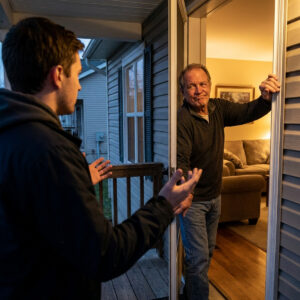
The drive to Uncle Rick’s house took fifty minutes, the sky a bruised purple as the sun dipped low. We arrived in a suburb of cookie-cutter homes, where the only landmark was Rick’s massive inflatable turkey on the lawn—a monument to his own self-importance. The driveway was a visual map of the family hierarchy. Mom’s sedan was in the prime spot, followed by Allison’s car. I parked my pickup on the street, the heavy scent of smoked brisket wafting from the back. Through the front windows, I could see them. It looked like a stage play. Rick was in the center of the room, drink in hand, holding court. My mother and Aunt Emily were laughing. It looked warm. it looked like family. But the moment I reached for the door handle, the play changed.
The door opened only six inches before Uncle Rick’s frame filled the gap. He didn’t greet me; he stood there like a bouncer protecting a VIP lounge. “You’re not family anymore, Evan,” he said, his voice flat and smug. “And she needs to leave, too.” I laughed, a short, sharp sound of genuine confusion, waiting for the punchline. It never came. Rick didn’t move. Behind him, my mother appeared, swirling a glass of wine. She looked at Maya with a coldness that felt like a physical blow. “This is only for family,” she echoed. Then Allison stepped up, smiling at Maya with a terrifying lack of empathy. “She’s only here because you’re the one who pays for everything,” she chirped. I looked past them into the dining room. There, at the spot where my name card had sat for nearly twenty years, was a man I barely knew—Allison’s new boyfriend. My mother handed him my plate. They clinked glasses. My life had been replaced before I even crossed the threshold.
The silence in the truck as we drove away was heavier than any equipment I’d ever carried. We pulled over four blocks away, the engine idling, the world blurring outside the windshield. My hands were shaking on the steering wheel—not with sadness, but with the violent clarity of a man who had just seen the ground rushing up to meet him. Maya’s voice broke the quiet, soft but steady. “They don’t miss you, Evan. They lose access.” She wasn’t crying. She was just stating a fact. She reminded me that the moment I showed up with someone who actually saw me, they had to cut me out to protect the lie. In that moment, I reached for my phone. I didn’t scream or storm back to the house. I simply opened the family group chat of twenty-six people and typed four sentences that would dismantle their world.
“If I am not family, I am not your wallet. Effective immediately, all payments are halted. Do not contact me for money again.” Then, I attached the file. It was a comprehensive Excel spreadsheet—six years of every cent I had spent to keep them afloat. Every car repair, every utility bill, every “emergency” loan. I showed it to Maya. She nodded once. “Send it.” I pressed the button and we sat there, waiting for the explosion. It took four minutes. My phone didn’t just ring; it screamed. But it wasn’t my mother or Rick. It was my cousin Lucas. “Where are you?” he demanded. When he arrived three minutes later and climbed into the back seat, he was staring at the ledger on his screen. “Sixty-one grand,” he whispered. “You paid for their lives while they treated you like trash.” He told me how the dinner had imploded. How Mom turned white, how Rick tried to claim I was lying until the evidence was undeniable. Lucas, Noah, and Emily had walked out right then, leaving the “family” table half-empty and the truth sitting in the middle of the room like a bomb.
The days that followed were a masterclass in psychological warfare. The messages came in waves—first the gentle, “damaged” voicemails from my mother, then the aggressive, pushy demands from Rick, and finally the victim-playing texts from Allison. By 1:00 AM, I had fifty-two unread messages. I didn’t respond to a single one. Instead, I sat in the blue light of my laptop and methodically severed the cords. I canceled the auto-payments for Mom’s car, Rick’s insurance, and Allison’s phone. I removed them from my accounts and my life insurance. I was a ghost again, but this time, it was by choice. My lawyer, Jonathan Reed—a man who looked like he had spent forty years staring down liars—confirmed what I already knew: I had the documentation to prove a pattern of harassment if they didn’t stop.
But they didn’t stop. They escalated. Rick showed up at my apartment and my workplace. My mother called my supervisor, claiming I was having a “mental breakdown” and was “erratic.” They even targeted Maya at the bakery, with Aunt Patricia filming her through the window, trying to frame her as the puppet master who had stolen their son. It was a smear campaign designed to isolate us, to make us doubt each other. They used every tool in the toxic family handbook: guilt, intimidation, and reputational damage. But every time they struck, we documented. Every doorbell camera clip, every “welfare check” by the police that turned out to be a fake report, every manipulated Facebook post—it all went into Jonathan’s file. We weren’t fighting; we were building a fortress.
The courtroom was quiet, save for the sound of the judge flipping through fifteen pages of evidence. My family sat in the gallery, dressed in their Sunday best, ready to play the victims one last time. But the judge was looking at the timestamps. She was looking at the “welfare check” I’d proven was a lie. She was looking at the videos Aunt Patricia had edited to make us look like the aggressors. When my mother tried to claim she was just “concerned,” the judge cut through the noise. “You informed his employer, created bogus police reports, and harassed his girlfriend. That’s not concern. That is control.” The protective order was granted for fourteen months. The silence that followed was the first real peace I had known since I was a child.
Five years have passed since that Thanksgiving door was slammed in my face. I have a house now, with a yard and a wife who sees me even when I’m not standing on top of a skyscraper. Lucas and Emily are still by our sides, the family we chose instead of the one we were given. Allison eventually reached out, not with a demand, but with an apology and a check for $3,500—a small start on a long road of accountability. As for the rest? They are still shadows. My father finally called to apologize for his silence, acknowledging that he chose the path of least resistance while I was being crushed. I’ve learned that family isn’t a blood bond; it’s a series of locked carabiners. You have to trust the equipment. I’ve finally gathered the right gear, and for the first time in my life, I’m not afraid of the fall.
Disclaimer : This content may be created by AI for entertainment purposes. Any resemblance to real persons, events, or places is coincidental.