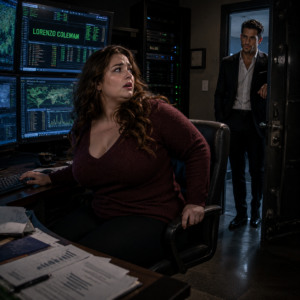
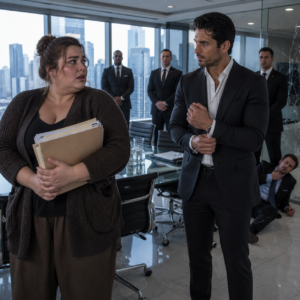
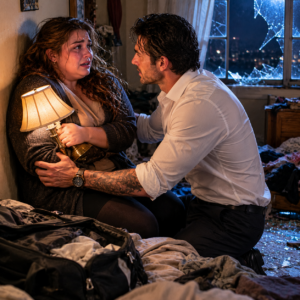
The Invisible Breath of the Earth: Catalina Vargas and the Winter of the Wolves
In the biting February of 1887, the New Mexico Territory had become a landscape of crystalline death. The thermometer had plummeted to a staggering 40 degrees below zero, and the wind didn’t just blow; it shrieked like a thousand hungry wolves circling a desperate prey. In the small settlement of Las Cruces, a surreal scene unfolded that defied every law of the frontier: while the wealthiest families in the county were frantically hacking up their mahogany dining tables and burning their last heirlooms just to keep their blood from freezing, one small house stood in an eerie, profound silence. No smoke curled from its chimney. No man stood outside splitting wood against the gale. And yet, inside, behind windows fogged thick with a mysterious, radiant heat, two children slept with the peaceful respiration of a summer’s nap, while their mother sewed by a lamp, her fingers moving with a calm that bordered on the supernatural.
This is the untold chronicle of Catalina Vargas—a woman who arrived with no husband, no gold, and zero respect, only to bury rusted iron in the dirt and become the savior of those who had branded her a lunatic.
The autumn of 1886 had been a season of dust and whispers. Catalina Vargas had crested the horizon of the valley with nothing but an ancient, braying mule and two children whose eyes were too large for their sunken faces. She came from the south, from lands that had once been Mexico but were now being carved up by the English language and iron fences. Her husband had died six months prior—not in a glorious battle, but in the muddy indignity of a harvest accident, crushed by a panicked horse. There was no inheritance, only a debt that swallowed their home and left Catalina with only what could fit in a borrowed cart.
When she stepped into the center of Las Cruces, the townspeople didn’t see a pioneer; they saw a casualty. The local social hierarchy was as rigid as the coming frost. Thomas Brenan, the bank owner whose brick mansion sat like a fortress on the hill, viewed her as a potential source of cheap labor. He offered her a job as a laundress—two dollars a month and a shack behind the stables where the smell of manure never dissipated. The Reverend Morrison, standing on the porch of the church, remarked to the elders that she “wouldn’t last a single winter.”
Catalina’s eyes, however, held a glint of ancestral iron. She didn’t want their shacks, and she certainly didn’t want their pity. With the last three dollars sewn into the hem of her skirt, she bought a rocky, tree-less patch of land at the very end of the road. It was a lot that even the poorest squatters avoided because it offered no timber for fire and no shelter from the north wind. But Catalina wasn’t looking for wood. She was looking for the “invisible breath.”
“The Earth does not forget the heat of the summer, child, and she does not feel the bite of the frost,” her grandfather had once told her. He was a Zapotec man who had watched a century of seasons pass, and his voice lived in Catalina’s head like a compass. Under the scorching September sun, while her neighbors were busy stockpiling coal, Catalina began to dig. She didn’t dig a foundation for a house; she dug trenches—six long, parallel gashes in the earth that looked like the ribs of a giant animal buried alive.
The town grew obsessed with her “madness.” Margaret Brenan, the banker’s wife, would pause her carriage on the road, watching through a lace parasol as Catalina, her hands raw and bleeding, moved mountains of rock. “Dear, the church has a fund for widows,” Margaret called out one afternoon, her voice dripping with a condescension that felt like a slap. “You don’t have to kill yourself digging like a common beast.”
Catalina didn’t even look up. “I am building a house that breathes, Señora. I suggest you ensure yours can do the same.”
The ridicule reached a fever pitch when Catalina visited Patrick O’Malley, the local blacksmith. O’Malley was a man of soot and pragmatism, and when Catalina asked to buy 40 meters of rusted, discarded irrigation piping, he nearly choked on his pipe. “That’s junk, woman! It’s full of holes. It won’t hold a drop of water.”
“I don’t need it to hold water,” Catalina replied, placing her coins on the anvil. “I need it to breathe the earth’s lungs.”
O’Malley took the money, shaking his head. He told his wife that night that the “Mexican witch” was burying trash to cast a spell on the valley. But as Catalina laid those pipes in the bottom of her trenches, she was sealing the joints with a mixture of clay and horsehair—an ancient sealant that would allow air to pass but keep the moisture of the soil out. She was creating a geothermal lung, a subterranean circulatory system that would pull air through the constant 55-degree temperature of the deep earth before it ever entered her home.
While the “civilized” world of Las Cruces relied on the Boston-made cast-iron stoves that Thomas Brenan sold at a massive markup, Catalina was molding the earth itself. She spent six weeks making adobe blocks—a mixture of straw, sand, and the grey clay from the creek. Each block was a testament to patience. She dried them in the fading autumn sun and stacked them into walls that were half a meter thick.
The Captain James Rutherford, a veteran of the Civil War who prided himself on his military-grade coal furnace, stopped by her site as the first frost touched the grass in October. He looked at her tiny, one-room adobe cube and laughed. “Señora, I don’t know what they told you in the south, but in a civilized territory, houses need fire, not magic mud. You’ll be begging for a bucket of my coal by Christmas.”
Catalina apisoned the last bit of earth over her buried pipes. “This is not magic, Captain. It is physics. While you are busy burning your money to stay warm, I will be letting the Earth do the work for me. The air will travel twenty meters under the ground before it touches my floor. By the time it reaches my children, it will have forgotten the North Wind.”
Rutherford walked away, muttering about the “ignorance of the peasantry.” He didn’t understand that the thick adobe walls would act as a thermal battery, and the buried pipes would act as a constant heat exchanger. Catalina had spent her last cent on seeds and cornmeal. She had no coal, no woodpile, and no fear.
The first “warning” from nature arrived in November. The temperatures dipped to zero at night. In the Brenan mansion, the servants were kept busy day and night, hauling three tons of wood into the various fireplaces. Despite the opulence, the house was a nightmare of thermal inconsistency—you were either scorching your face near the hearth or feeling the ice-water draft of the hallways.
In the Morrison household, the Reverend’s wife was already weeping. The green wood they had purchased cheaply was full of moisture; it hissed and groaned in the stove, producing a thick, acrid smoke that made the children cough until they vomited. The soot began to coat the white lace curtains, a black film that felt like a premonition of the grave.
Yet, as Margaret Brenan walked past the Vargas lot, she saw the two children, Miguel and Rosa, playing in the dirt in front of their adobe house. They weren’t shivering. They weren’t wrapped in heavy furs. And most confusingly, there was no smoke coming from the chimney—because there was no chimney. The house sat there, a silent, grey block of earth, seemingly dead to the world. “They must be huddled under blankets, starving in the dark,” Margaret whispered to her friends.
But inside, it was 60 degrees. The air coming up through the floor vent was temperate and sweet, filtered by the very soil it traveled through. Catalina sat by her window, the glass clear and free of ice, sewing a quilt she intended to sell in the spring. She sang Zapotec songs of survival, her heart light because she had proven the Earth’s loyalty.
Then came January 21st. History books would later call it the “Winter of Death.” At 3:00 PM, the sky didn’t just darken; it turned the color of a fresh bruise. The wind arrived with a roar that shook the very foundations of the valley. It wasn’t falling snow—it was a horizontal assault of ice needles that blinded cattle and froze birds mid-flight.
In Thomas Brenan’s house, the terror began when the wood ran out. The blizzard was so fierce that his workers couldn’t reach the woodshed only twenty yards away. One man tried and was found three days later, a frozen statue leaning against the barn. In desperation, the richest man in the county began to break his furniture. He smashed the mahogany chairs. He tore the doors off the wardrobes. He fed his legacy to the flames just to keep his children’s fingers from turning blue.
At the Rutherford estate, the coal furnace proved to be a treacherous god. The intense heat against the freezing exterior caused the chimney to crack, venting carbon monoxide into the bedrooms. The Captain’s youngest grandson stopped shivering—the most dangerous sign of hypothermia. The body had given up the fight.
By 9:00 PM, the pride of the “modern” world had been utterly shattered. Thomas Brenan, wrapped in a tattered quilt, looked at his wife and knew they were going to die in their brick tomb. He thought of the only house in the valley that didn’t rely on the whims of a woodshed or a coal train. “The adobe,” he gasped. “We have to get to the adobe.”
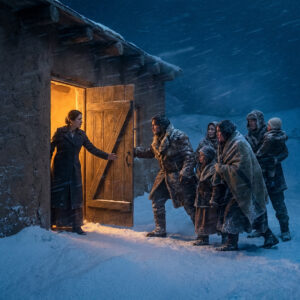
The trek of 100 meters felt like a journey across the Arctic. Brenan carried his daughter; Rutherford followed, clutching his dying grandson to his chest. The Reverend’s wife dragged her unconscious husband on a makeshift sled through the waist-deep drifts. They reached Catalina’s door and hammered with the desperation of the damned.
When Catalina Vargas opened the door, the light that spilled out wasn’t the flickering orange of a fire; it was the steady, warm glow of a sanctuary. She stood there, barefoot on the warm earth floor, wearing only a light cotton dress. Behind her, Miguel and Rosa looked on with wide, curious eyes.
“Move quickly,” Catalina said, her voice a calm anchor in the storm. “Close the door before the Earth’s breath escapes.”
Thirteen people huddled in that six-square-meter room. They sat on the floor, their eyes bulging as they felt the warmth emanating not from a stove, but from the very ground beneath them. Catalina didn’t lecture them. She didn’t remind them of their laughter or their “Widow’s Fund.” She simply moved the children to the side and placed the Captain’s grandson directly over the floor vent. Within minutes, the boy began to tremble—a violent, beautiful shivering that signaled his blood was moving again. He was alive.
The storm raged for seventy-two hours. Outside, the world was being erased. Houses were buried to their rooflines; the valley became a silent, white morgue for seventeen people who didn’t make it to the adobe. But inside Catalina’s walls, the air remained a constant, life-saving temperate.
She fed the entire group from her store of beans and tortillas, rationing the water she had stored in clay jars. In the forced intimacy of the dark room, the social order of Las Cruces dissolved. Thomas Brenan sat shoulder-to-shoulder with the woman he had tried to hire as a servant. The Reverend Morrison, his lungs clearing for the first time in months, listened as Catalina explained the “magic” of her grandfather’s pipes.
“You built a palace out of the air,” Brenan whispered on the second night, watching the steam rise from his damp coat.
“I didn’t build a palace, Señor Brenan,” Catalina replied, her eyes reflecting the lamplight. “I built a relationship with the ground you walk on. You spent your life trying to conquer this land. I spent mine learning to ask it for a favor.”
When the sun finally emerged on the fourth day, the valley was unrecognizable. The devastation was absolute—the “modern” infrastructure of the west had been proven impotent against the raw power of the earth. But as the 22 survivors emerged from the adobe hut, they walked out as different people.
Thomas Brenan never looked at a brick the same way again. In April, he hired O’Malley—not to build a fireplace, but to excavate his mansion and install the “Mexican pipes.” The Captain wrote an anonymous article for the territory’s newspaper titled The Wisdom of the Forgotten, detailing the geothermal principles that had saved their lives.
Catalina Vargas lived in that house until she was 84. She never became a millionaire, but she became the unofficial architect of the territory. Families from as far as Montana sent for her “blueprints,” and she would tell them the same thing: “Don’t look for the fire in the sky; look for the fire in the dirt.”
Today, we call it Geothermal Earth-Tube technology. It is studied in universities and implemented in high-end eco-homes. But it was born in theRaw calloused hands of a “mad” woman who knew that the earth’s heart is warmer than man’s pride. Catalina Vargas reminds us that when the world turns cold and the wolves begin to howl, the most sophisticated solution is often the one that has been beneath our feet all along.
How often do we ignore the simplest, most natural solutions because they don’t look “modern” enough? Have you ever witnessed a piece of “old wisdom” outshine a modern invention? Share your thoughts and stories below—let’s remember the wisdom of those who came before us.