They Came For The Money, Not Knowing Their Daughter Controlled The Entire Room

The air inside the county courtroom felt like it was composed of old dust and cold iron. It was a sterile, unforgiving atmosphere, the kind that usually stripped a person of their confidence the moment they crossed the threshold. But as I sat at the petitioner’s table, I noticed that my father had already managed to make the space his own. He was leaning back in his chair, his suit pressed with a surgical sharpness, his hands lying flat and relaxed on the polished wood. He looked comfortable. That was the first thing that cut through my professional armor—the sheer, unadulterated comfort of a man who believed the world was a machine that only functioned to serve his interests. Beside him, my mother sat with a rigid grace, her pearls catching the harsh fluorescent light, her eyes fixed on a point somewhere above the judge’s bench. They were here for the numbers. They were here for the house on Maple Street. They looked like people waiting for a minor bureaucratic delay to resolve itself so they could finally collect what they believed was rightfully theirs. They didn’t look like parents. They looked like heirs. My father didn’t flinch when his eyes met mine; he held my stare with the same quiet, lethal certainty he had used twenty years earlier when he decided that my life was a file he could simply close and forget. He didn’t see the woman I had become. He only saw the obstacle between him and a six-figure bank account.
The memory of that Sunday night twenty years ago didn’t arrive in flashes; it arrived in textures. I could still feel the way the handle of the old blue suitcase had bitten into the soft skin of my palm. I could still hear the rhythmic thrum of the rain hitting the porch roof, a sound that usually meant safety and sleep, but that night, it sounded like a countdown. I was sixteen years old, my body a foreign country I was still trying to map, carrying a secret that had turned me into a stranger in my own hallway. My father hadn’t shouted. He wasn’t a man who wasted energy on volume. He had simply stood there, his shadow long and dark against the floral wallpaper of our foyer, and spoken with a voice that was as clean and dry as a bone. He told me I had made a choice, and that the consequence was that I could no longer exist under his roof. He spoke as if he were discussing a late library book rather than his only daughter.
My mother’s betrayal was quieter, which made it the kind of wound that never truly closed. She hadn’t looked at me once while she packed my things. I watched her from the doorway of my bedroom, my chest tight with a panic that felt like it was swallowing my heartbeat. She moved with an efficiency that was terrifying. She folded my sweaters, my jeans, and my church retreat shirts as if she were preparing a guest room for someone she didn’t particularly like. When the suitcase was full, she zipped it with a definitive, metallic snap. She didn’t offer a hug. She didn’t offer a “take care.” She simply set the bag by the front door and walked back into the kitchen to finish the dishes. The clink of silverware against ceramic was the last sound I heard before the front door clicked shut behind me.
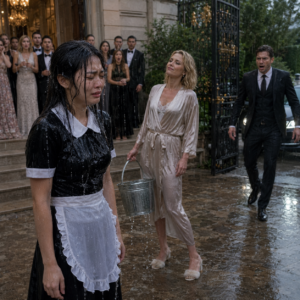
Standing at the end of that driveway, I felt the cold rain slip down the back of my neck, a physical reminder that I was now entirely responsible for the air in my lungs. The porch light was still on, casting a bright, mocking glow over the wet asphalt. I looked at the dark windows of my parents’ room and understood for the first time that blood was not a bond; it was a biological accident that could be revoked at any time. I had forty-three dollars in my pocket and a phone that was dying, but more than that, I had the realization that rescue wasn’t coming from the people who had raised me. I had to walk. I had to move toward the only person in town who didn’t measure love in terms of reputation. My grandmother’s house was three miles away, a distance that felt like a continent when you were sixteen and carrying a suitcase that felt like it was filled with lead. Every wet step I took was a silent vow that I would never again allow myself to be placed in a position where someone else could decide whether I was worth a dry place to sleep.
Grandma Edie’s house always smelled of lemon soap and the faint, earthy scent of lavender sachets hidden in the linen closets. When I finally reached her porch, I was shivering so violently that I could barely coordinate my fingers to knock. When the door opened, I expected a lecture. I expected questions about how I could let this happen. I expected the same wall of judgment I had just escaped. Instead, I found a woman in a quilted robe who looked at my soaked clothes and my tear-stained face and did the only thing that mattered. She pulled me inside. She didn’t ask for a story while I was still dripping on her linoleum. She just took the suitcase and pointed toward the bathroom.
“Bathroom. Towels are on the shelf. I’ll put the kettle on,” she said. It was the most beautiful sentence I had ever heard. It was an instruction for survival. While the hot water washed away the grit of the road and the sting of the rain, I sat on the edge of the tub and held my stomach. For the first time since the test had turned positive, I felt like the baby wasn’t a mistake or a problem to be solved—he was a person who had just been invited into a home. When I walked into the kitchen, the yellow light above the table felt like a sanctuary. Edie had placed a mug of tea in front of an empty chair and waited for me to find my voice.
I told her everything—the boy who had disappeared, the hallway, the way my mother had folded my clothes like a chore. Edie listened with a stillness that was profound. She didn’t wring her hands or sigh with disappointment. She just watched me with those pale blue eyes that had seen the Great Depression, a world war, and a husband’s funeral. When I finished, I whispered that my parents said I had made my choice. That was the moment Edie reached across the table and took my hand. Her skin was thin and papery, but her grip was like iron. “Then I am making mine,” she said. In that one sentence, she dismantled my parents’ authority. She didn’t just give me a room; she gave me a foundation.
The first few months were a blur of morning sickness and the strange, quiet hum of the Buick as she drove me to school. I was terrified of the hallways, of the whispers that followed me like a shadow. But Edie would drop me off at the curb, look me in the eye, and tell me to keep my chin level. She taught me that I didn’t owe the world my shame. She bought a secondhand crib and spent an entire Saturday afternoon scrubbing it until the spindles shone, acting as if preparing for a baby was a normal, happy task rather than a scandal to be hidden. She never treated me like a “situation.” She treated me like a mother-to-be who simply needed a little help with the heavy lifting.
Noah was born into a world of cardigans and quiet strength. He was a tiny, fierce thing, and the moment I held him, the panic returned. I didn’t know how to do this. I was seventeen, I had no money, and the boy who should have been there was a name I was already starting to forget. But Edie was there, standing by the hospital bed with a bad haircut and red eyes, telling me that nobody good begins by knowing—we begin by staying. And we did stay. We stayed through the colicky nights when Noah cried for hours and I cried with him. We stayed through the shifts at the diner where I wore black sneakers and smiled at strangers for tips while my brain was busy memorizing vocabulary words for my GED.
The kitchen table became the center of my universe. It was a humble piece of furniture with a wobble that Edie had “fixed” with a folded piece of cardboard, but it was where I built my future. Every night, after Noah was tucked into the crib Edie had scrubbed, I would sit under that humming yellow light. I studied high school math, then community college English, then the dense, terrifying pages of law school prep books. My hand would cramp from the highlighter, and my eyes would burn from the effort of making the words stay still on the page.
I remember waking up at that table more times than I could count, my cheek pressed against a casebook, and finding a blanket draped over my shoulders. The gray one. It was frayed at the edges and smelled like the lavender Edie used in her laundry, and every time I found it there, I knew she had been watching. She never woke me up to tell me I was working too hard. She never demanded I thank her for the tea she left beside my hand. She just covered me. She treated my ambition like something that deserved protection. My parents had treated love like a transaction—something they would only provide if I stayed within the lines they had drawn for me. Edie treated love like a floor. It was just there, solid and unmoving, so I could walk on it without looking down.
When I graduated from law school, the auditorium was full of parents who had paid for their children’s tuition and mailed them care packages. I didn’t envy them. I looked at the third row and saw Edie, looking small in her navy church dress, with twelve-year-old Noah sitting beside her. When my name was called, Noah didn’t just clap; he stood up and shouted. The sound of his voice—the voice of the child my parents had tried to erase—echoed off the rafters. Edie didn’t shout. She just looked at me and touched two fingers to her heart. It was a gesture that said she hadn’t just held the light for me; she had always known I would find the door.
Passing the bar and becoming a prosecutor changed the way I moved through the world, but it didn’t change the house on Maple Street. I still came home to the smell of bread and the sight of Noah doing his homework at the same table where I had once cried over my first college acceptance. But Edie was getting older. She was slowing down, her movements becoming careful and deliberate. She began to wave off my concerns, calling her age a fact rather than an emergency, but I saw the way she held the banister. I saw the way she sat on the porch and watched the afternoon light move across the tulips she had planted the night I arrived.
Her passing on a Sunday morning was as quiet as her life had been. Noah and I were both there, holding her hands, listening as her breathing became a series of long, soft pauses. When the house went silent, it didn’t feel empty; it felt like it was holding its breath. The funeral was small—just the people from church and the cashiers she had chatted with for years. My parents didn’t come. A cousin told me they had “heard about it,” a phrase that made it sound like her death was a weather report from a distant county. I felt a flicker of the old anger, but it was quickly replaced by a profound sense of relief. I didn’t want them in her space. They didn’t deserve the lavender scent or the memory of the gray blanket.
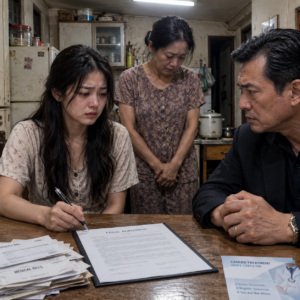
A week later, I sat in the office of Harold Bennett, Edie’s long-time attorney. I expected a simple reading of a simple will. I knew the house was coming to me, and I was ready to protect it. But when Harold opened the folder, he didn’t just talk about property lines. He talked about a trust. Six hundred eighty thousand dollars. I felt the blood drain from my face as I stared at the digits on the page. It was a number that didn’t make sense in the context of Edie’s modest life, her thrift-store cardigans, and her cardboard-fixed table.
“She didn’t want you to know,” Harold said, sliding a handwritten letter across the desk. I recognized the slant of the words immediately. Edie had written that she didn’t want the money to be a rescue rope; she wanted it to be a floor. She wanted me to build my own life first, to know I could stand on my own feet, so that when I finally received the money, it would be a foundation for Noah’s future rather than a crutch for my survival. She had been building it for twenty years—small deposits, careful investments, and a patience that bordered on the divine. She had watched me count coupons at that kitchen table while she sat on a fortune, all because she knew that the strongest people are the ones who have to build their own way out of the rain.
The phone call from my mother, “Elaine,” came thirty-six hours after the news of the trust hit the local grapevine. Her voice hadn’t changed—it still had that sharp, impatient edge, as if she were being inconvenienced by my existence. She spoke about “the family portion” and “rights” as if twenty years of silence were a minor clerical error she could overlook for the right price. I told her there was nothing to discuss. I told her she had rights to a daughter once, and she had zipped them into a blue suitcase and left them on a porch. When my father called later that day, trying to sound reasonable and paternal, I didn’t even argue. I just saved the voicemail. Prosecutors know that you don’t fight a lie with words; you fight it with a record.
Now, sitting in the courtroom for the hearing they had filed to contest the will, I watched them. They were arguing that Edie had been “unduly influenced” by her proximity to me. They were suggesting that her mind had failed her, and that she had redirected “family assets” that belonged to them. Their attorney, Simon Hale, was a man I knew well—a polished litigator who was used to winning by using complicated sentences to hide simple truths. He spoke about “broader family structures” and “expectations of fairness.” He sounded very convincing until he stopped talking.
My attorney, Mara, didn’t make a speech. She just started handing out the evidence. The dates of the deposits. The medical evaluations Edie had insisted on every time she updated the trust, proving she was of sound mind. The letters Edie had written to Harold Bennett, explaining in plain, unshakeable English exactly why her daughter and son-in-law were not to receive a single penny. Mara read the final line of the last letter aloud, her voice steady and clear: “I am leaving this to the ones who came, and to the child who made this house a home after others decided he did not belong in theirs.”
The courtroom went so quiet I could hear the hum of the air conditioner. My mother flinched as if she had been struck. My father’s hand, which had been so comfortable on the table, shifted just an inch—the first sign of a crack in his armor. Simon Hale reached for the last set of documents, his professional smile fading as he realized he had been hired to defend a story that didn’t exist. He looked at the signature on the response Mara had filed, then he looked at me. He had seen my name a hundred times in the local filings, but he had never put the “Prosecutor Avery” together with the “Alyssa” in his clients’ bitter stories. His shoulders straightened, and his voice dropped into a register of genuine professional respect. “Good morning, Prosecutor,” he said. The shift in the room was instantaneous. My parents weren’t just losing a case; they were realizing that the daughter they had discarded as a “problem” was now the authority they were forced to answer to.
The judge’s ruling wasn’t just a legal victory; it was a formal recognition of the truth. He dismissed the claim with a sharpness that left my parents stunned. He noted that the record reflected a “deliberate, consistent, and documented intent” that spanned two decades. He didn’t use the word love, but it was there in every date and every dollar sign he cited. When he said, “Ms. Avery’s wishes will be respected,” I didn’t look at my parents. I looked at the empty chair behind me where I knew Noah was sitting, and I felt the weight of Edie’s gray blanket settle over my shoulders one last time.
In the corridor afterward, my father tried to call my name. “Alyssa,” he said, his voice sounding thinner than it had in the room. He told me they “didn’t know what I had made of myself.” It was an apology wrapped in a justification, the last gasp of a man trying to find a way to be right even when he was wrong. I turned to look at them, and for the first time in my life, I didn’t feel like a sixteen-year-old in the rain. I felt like a woman who had kept the record. I told them they didn’t get to reopen my life because they lost a case. I told them they didn’t get to call their absence “complicated” when the documentation showed it was a choice. I looked at my mother, whose pearls looked like a chain around her neck, and told her that we were still parents and daughter—and that was the saddest part of the entire day.
Noah and I drove back to the house on Maple Street in a silence that felt like peace. The tulips were in full bloom along the fence, bright splashes of red and yellow against the green lawn. We went into the kitchen and I put the kettle on, the sound of the water filling the pot acting as a coda to the years of struggle. I took out three mugs. One for me. One for Noah. And one for the chair by the window. We sat there together as the sun began to set, the light stretching across the table where we had both grown up. Legacy isn’t about being there for the end of the story; it’s about building a house that knows how to keep its own lights on long after you’re gone. I was sixteen when I was sent away, but I was thirty-six when I finally realized I had never truly left. I had just been waiting for the record to catch up to the heart.
Call to Action: Sometimes the people who are supposed to protect us are the ones who leave us in the rain. But sometimes, a single person opening a door can change the trajectory of an entire generation. Have you ever had a “Grandma Edie” in your life—someone who gave you a floor to stand on when the world felt like a storm? Share your story of resilience and unexpected support in the comments below. Let’s honor the ones who chose us.
Disclaimer : This content may be created by AI for entertainment purposes. Any resemblance to real persons, events, or places is coincidental.