Nurse Got Stabbed Saving an Army Ranger Captain, 5 Hours Later, the Military Showed Up in Force
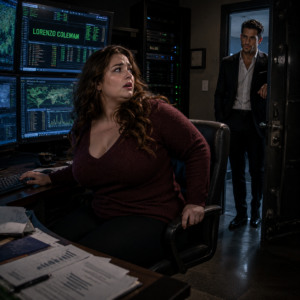
The new nurse kept her eyes on the floor tiles. That was the first thing Dr. Harrove noticed about Katie Rodriguez as she moved through the orientation hallway at Mercy General. Her badge clipped to a lanyard that read week one in permanent marker. She’d arrived in Savannah 3 days ago with a single duffel bag that she stored in the nurse’s locker room, and she wore the same Navy scrubs every shift, freshly pressed with the kind of creases you only got from military discipline or obsession.
Harrove had seen plenty of new hires shuffle through Mercy General’s corridors over his 15 years as the department senior physician, anxious residents, eager nursing students, the occasional mid-career transplant, looking for a smaller city advantage. None of them lasted more than 6 months. Katie Rodriguez looked like she was already counting down to her last day, and he hadn’t even spoken to her yet.
But that wasn’t what made him notice her. That wasn’t what made his jaw tighten on the morning of her second shift. It happened during rounds in the ICU. Harrove was walking the department 16 beds with his customary entourage, two residents, a medical student, and the senior floor nurse, Susan Chen, who’d been his right hand for 7 years and understood the hierarchy perfectly.
Katie was repositioning a patient in bed seven, a posttop cardiac case, her hands moving with the kind of mechanical precision that suggested she’d done this exact maneuver thousands of times. The fingers were steady, the movements were silent, and when Harroo’s group approached the patients bedside, something happened that he’d spent 15 years carefully cultivating against.
Susan stepped back. Not dramatically, not obviously to anyone watching casually, but she angled her body slightly, created space, moved just enough to position Katie closer to the monitor and the medication cart. It was a small gesture, barely conscious, the kind of thing that takes months or years to unlearn, the instinct to defer to someone who knows what they’re doing really knows.
The way you know which way is north without checking a compass. Harrove’s eyes narrowed. Katie didn’t acknowledge it. She continued her work without looking up, checking me full line, verifying the monitor leads, writing something on the patient chart in handwriting so neat and precise it looked typed. When she finally glanced at him, her dark eyes met his for exactly half a second before returning to her task. “Morning, Dr.
Harrove,” she said quietly. “Patients vital stable. No overnight events. It wasn’t disrespectful. That was the problem. If she’d been disrespectful, he could have addressed it. But she’d simply reported briefly, accurately, as if she was the one responsible for the patients care, not him. As if she didn’t understand that he was the one who made decisions here.
He said nothing and moved to the next bed. But the tension in his shoulders stayed, a weight that didn’t lift through the next three patients or the final two rounds of the morning. By noon, he was in the physician’s break room. It was empty except for Katie, who sat at the corner table with her lunch in a clear plastic container, grilled chicken, brown rice, steamed broccoli, nothing else, and a bottle of water.
No soda, no coffee, no snacks. The kind of disciplined eating that made Harrove think of militarymies and training camps. He’d served a rotation in the Army Reserve in his 30s, hated every minute of it, and the memory made him want to undo whatever advantage this woman thought she had. He pushed through the door with enough force to make it swing open hard.
The sound made her look up, but she didn’t startle. “Let me be clear about something,” Harrove said, his voice pitched to carry beyond the room, angled so that two nurses passing in the hallway would hear him. “$50 says you quit by Friday.” He let that land. Watched her face for a reaction. New staff always struggle with the pace here. It’s fine. It’s not for everyone.
Better to know now before you get too attached. Katie set down her fork. She took one measured breath. The kind of breath that seemed intentional, practiced, something she’d learned to do under pressure. Then a single tear escaped from her left eye. just one clean, precise, and she wiped it away without breaking eye contact.
The movement was so calculated, so controlled that it wasn’t sadness at all. It was something else, a message. When she spoke, her voice was lower than before. Quieter. The kind of quiet that makes people lean in to listen. I’ve survived worse mornings than you’ll ever imagine, doctor. The words hung in the break room.
In the hallway beyond, the nurses had stopped walking. Harrove opened his mouth to respond, to reassert his dominance over this conversation. But something about her eyes, flat, dark, utterly composed, made him hesitate for half a second. Just half a second. That was all she needed to return to her lunch, dismissing him with a kind of casual indifference that made his skin burn hot. He turned and left.
behind him. He heard her take another sip of water. What happened next didn’t just involve protocol violations. It involved something far more complicated than he understood. Harrove had built his authority at Mercy General on visibility and volume. He was loud in rounds. He corrected residents publicly. He made jokes about new staff that everyone laughed at because you had to because he was the one writing their evaluations.
His power came from being unavoidable, from filling spaces so completely that there was no room for anyone else’s competence to show. It had worked perfectly for 15 years because he’d never encountered someone who seemed genuinely uninterested in his approval. Katie worked her first official shift as a floor nurse that afternoon.
Hargrove had deliberately requested her assignment to ICU rounds, which meant he’d see her stumble, would document her mistakes, could build a paper trail that would have her gone by week three. Instead, she moved through the 8-hour shift like she was gliding through water. Smooth, efficient, anticipatory. When a patient started showing early signs of arhythmia, she’d already adjusted the monitor sensitivity before Harrove even noticed.
When the crash cart needed restocking, she restocked it. When a resident asked for a 16 gauge for needle on a diabetic patient with difficult veins, Katie had already retrieved a smaller bore and the ultrasound probe, laying them out without being asked. The residents noticed. He could see it in the way they asked her questions instead of waiting for him to ask them.
He could see it in the speed at which they moved when she suggested something needed attention. By the end of the shift at 8:00 p.m., she’d handled 17 patient interactions, and in exactly zero of them had she stepped outside her scope of practice or made a visible mistake. Harrove stood at the nurse’s station, watching her document something on the computer.
Her posture perfect, shoulders squared, the kind of posture you learned when someone had trained you for combat. His jaw clenched, his fingers curled into a fist, which he forced to relax by gripping the edge of the counter instead. The fluorescent lights buzzed overhead, a sound like electricity trying to escape.
And in that sound was the clear knowledge that something about his careful hierarchy had shifted. He’d been looking for a weakness. He hadn’t yet found one. Katie finished her charting at 8:17 p.m. She closed the computer down, checked the crash cart one more time, unnecessary, but she did it anyway, and turned to leave. The evening shift nurses were already settling in for their 12 hours.
The antiseptic smell of the ICU mixed with someone’s expensive cologne, and Katie paused for just a moment as if the smell had triggered something. Her jaw tightened, her eyes closed for exactly one second. Then she walked toward the elevators, her pace steady, her breathing controlled, the way someone walks when they’re carrying weight that nobody else can see.
When the elevator doors opened, Harrove could see her reflection in the polished stainless steel before she disappeared inside. Her face was blank. Professional, the kind of blank that comes from having already survived things worse than a doctor’s contempt. The doors closed. She was gone. Harrove turned back to the nurse’s station and stared at the empty chair where she’d been sitting.
Something in his chest felt like static electricity waiting for discharge. He’d underestimated her. That much was clear now. The question was what to do about it, and more importantly, why her quiet response in the break room had affected him more than the hundreds of confrontations he’d won over the years.
One of the evening nurses, a younger woman named Lisa, approached him hesitantly. Dr. Harrove, Katie wanted me to ask if you needed anything before she left. She said the night resident looked tired and might need support for the 2:00 a.m. rounds. Support. She’d offered to help even after his $50 insult. Even after he’d tried to intimidate her into quitting.
Tell her I don’t need her help, Harrove said, and then added because he couldn’t help himself. Tell her to enjoy her last few days before Friday. But as Lisa walked away, he realized something that made his hands clench again. Katie hadn’t been offering to help him. She’d been offering to help the night resident.
She’d been thinking about patient care, about the exhaustion of overnight shifts, about making sure the ICU didn’t collapse into chaos at 2:00 a.m. She’d been thinking about everyone except herself. That kind of thinking didn’t come from nursing school. That kind of thinking came from having actually mattered in someone’s life. From having held power that wasn’t about titles or hierarchy, but about the simple terrifying fact that someone else’s survival depended on your competence.
Harrove had spent 15 years building his kingdom. And in 3 days, he’d finally encountered someone who didn’t want it. The cafeteria crashed into silence like a building collapsing. Katie Rodriguez carried her lunch tray past the physician’s table. Tuna sandwich, apple, black coffee, when Dr. Harrove stood abruptly, his shoulder checking hers with the precision of a collision. The tray went airborne.
Soup splashed across white tile in a spreading arc. The crash echoing through 40 staff members who suddenly found their plates very interesting. A spoon clattered and kept clattering, spinning lazy circles on the floor. Harrove stepped over the mess without looking down. Careful, sweetheart. We can’t have clumsy hands in my ER.
His voice carried the tone of someone addressing a child who’d broken something cheap. The physicians at his table smiled. One laughed quietly into his napkin. Katie knelt slowly. She didn’t rush. One measured breath filled her chest. The kind of breath that came from a body trained to breathe through worse things than humiliation.
She began collecting pieces. Bread soaked with broth. The plastic bowl unbroken. Her hands moved with deliberate precision. Each motion controlled. Each gesture saying nothing at all. Around her, the cafeteria resumed its noise. Conversations were starting like engines turning over. But the nurses at the nearby table kept watching.
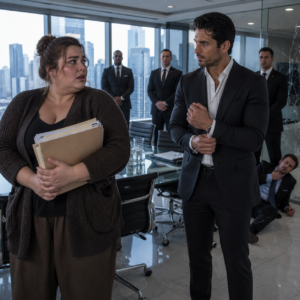
They didn’t look directly at her. They just watched. 20 minutes later, during trauma rounds, Har Grove threw a patient chart at her feet in front of the entire team. Paper scattered like startled birds across the conference room floor. Seven residents, two attending physicians, one charge nurse who’d been working at Mercy General for 18 years and had never seen a physician do this to anyone.
Pick that up, sweetheart. His voice was casual, almost friendly. New girls fetch. Katie crouched and gathered each page in perfect order. She’d learned to organize chaos in places where the stakes were measured in lives per minute. A chart was nothing, just paper, just words written by hands that didn’t understand what real pressure felt like.
She stood and handed the assembled pages back to him. And for 3 seconds, her fingers trembled, not from fear, but from the effort of holding something back, something that wanted to move, something that remembered how to respond to disrespect with finality. One tear escaped, just one. She wiped it away without breaking eye contact.
I’ve done this job in places where the charts were written in blood. Doctor, her voice barely above a whisper. I’ve survived worse mornings than you’ll ever imagine. The room went dead silent. The fluorescent light seemed to buzz louder in that silence. A mechanical drone that filled the space where sound had been.
Harrove’s face went crimson. Not the red of embarrassment, but the red of a man watching his power slip like water through his fingers. He turned away abruptly, muttering something about incompetence and attitude problems. But three nurses had already looked away from Katie, not in pity, in recognition. What he didn’t see was what came next.
Over the next 72 hours, Harrove escalated with the precision of a man who understood institutional systems like a musician understands scales. The nickname came first. He started calling her steadyquit in the breakroom with a smirk directed at whoever was listening. Because she looks steady, but she’ll quit like all the rest.
The other physicians laughed because that’s what proximity to power does. It makes people laugh at things that aren’t funny. Then came the restrictions. He told the charge nurse that Katie wasn’t authorized for level two trauma procedures without explicit verbal orders. He wrote her up for restocking the crash cart incorrectly, claiming she’d placed the epinephrine vials in the wrong sequence.
The sequence she’d organized was in fact identical to the sequence used by 340 combat hospitals in three countries. But that detail didn’t matter to paperwork. He began copying the hospital administrator on every email that mentioned her name, building a paper trail with the methodical patience of someone who’d learned that documentation was its own form of power.
By day six of her employment at Mercy General, Harg Grove had placed calls to two board members he’d known since medical school, his tone carefully calibrated to sound concerned rather than vindictive. Problematic new hire with an attitude issue, he told them. Potential liability. I’m documenting everything.
The lies were small enough to pass as opinion, big enough to stick. Katie absorbed each attack in silence. She came early, stayed late, moved through the ER with a kind of quiet competence that made people wonder if they’d imagined the incidents at all. But other nurses started watching her differently. Not with the pity that comes from seeing someone broken, but with the curiosity that comes from seeing someone unmoved by something that should have moved them.
Then Saturday evening arrived and the ER registered a traffic collision. Highway 16, Thunderbird intersection. One vehicle versus a commercial truck. Driver Marcus Chen, 28 years old, Army Ranger Captain in Savannah visiting his sister for 48 hours before flying back to Fort Benning. The truck had run a red light.
His sister had been driving when impact came from the passenger side. Harrove grabbed the case personally, barking orders with the voice of a conductor who’d rehearsed this symphony a 100 times. Get him to trauma, too. Portable chest X-ray. I want an EKG and troponin panel. Let’s move. The team moved because that’s what teams do when authority speaks with certainty.
Katie prepped the chest tube insertion tray. The movements came before thought. muscle memory from 8 years as a senior chief petty officer in the Navy from 19 combat trauma responses from a particular morning in Fallujah when she’d performed this exact procedure on a left tenant with a collapsed lung while rounds echoed off concrete walls.
She laid out the 14 gauge needle, the Kelly clamp, the endotracheial tube, the sterile field arranged like a surgical prayer, each instrument in the position her hands expected it to be. Harrove began the insertion procedure. His technique was competent, adequate, the kind of technique that filled textbooks and followed protocols.
Katie handed him instruments before he called for them. Scalpel, clamp, tube. E moving with the fluid precision of someone who’d anticipated every next moment because she’d lived this moment before in places where hesitation cost lives. The attending physician’s eyes raised. One resident leaned forward slightly, noticing.
Captain Marcus Chen was semic-conscious, sedated, but aware on some level that registered pain and movement and the presence of faces above him. His eyes tracked Katie’s face as she held pressure on the insertion site. Her touch steady, her breathing synchronized to the monitors beeping their electronic heartbeat.
Then something shifted in his pupils. Focus. Sudden and unmistakable, pushing through the morphine-like hands pushing through water. he whispered horsely. Each word or effort that cost him followed your technique. You were a combat medic. Katie’s hands didn’t falter. The needle went in. The tube followed. Her breathing stopped for 3 seconds, just three, while she processed the fact that her past had just woken up and said her name.
Harrove was barking something about oxygen saturation to the respiratory therapist. His voice a wall of noise that covered the moment. Katie turned away to dispose of sharps, her fingers shaking slightly as she placed them in the biohazard container. The trembling wasn’t fear. It was the physical memory of a body learning that it wasn’t as invisible as it thought.
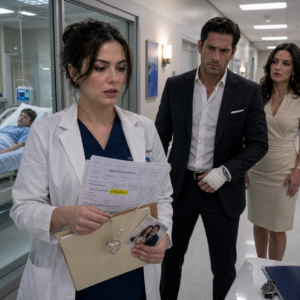
After the procedure concluded, vital stable tube placement confirmed on portable X-ray. Patient admitted to ICU for observation, Harrove pulled her into the hallway. His voice was low, meant for her alone, though he positioned himself just loud enough that nearby staff could hear. Your job is to hand me tools, not play surgeon.
Remember your place. Katie took one measured breath. One tear escaped down her cheek. She wiped it away with the back of her hand, never breaking eye contact. Her voice, when it came, was barely above a whisper, shaped by years of discipline, into something that cut like a blade despite its softness. I remember exactly what my place used to be. Doctor, that’s why I’m here.
She walked past him and didn’t look back. But Chen’s sister, who’d been standing 10 ft away in the ICU corridor, had heard every word. She’d also heard what her brother said to the nurse who’d intubated him with hands steady enough to be famous. She’d seen the look that passed between them. Not romance, but recognition.
The kind of look that happens when two people know the same terrible language. and realized they’re not alone in speaking it anymore. That night, after Chen was settled in his ICU bed with monitors humming their mechanical lullabi around him, Katie stood at her locker during the end of shift. She noticed that someone had left the chart from that morning’s humiliation sitting on the top shelf.
Someone had also written a single word underneath where Harrove had written, “Pick that up, sweetheart.” The word was legend. She stared at it for 6 seconds, not processing the meaning, just processing that someone had seen her. Someone had watched Harrove throw a chart and had drawn a conclusion that had nothing to do with subservience.
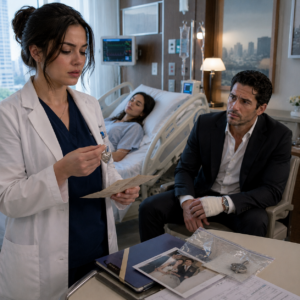
In ICU room for 12, Captain Marcus Chen lay in his hospital bed, staring at the jacket hanging in the closet, the one his unit had given him 5 years ago after the operation that changed everything. Inside the lining was a faded JSOC unit patch stitched there by hands that belonged to a Navy Corman with the call sign steady.
That corman had saved his entire squad on a morning in March, had carried two wounded rangers to the evac point while taking fire. Had kept bleeding long enough to give three other soldiers time to get to the birds. He’d never seen that corman after Tickrit. Had wondered sometimes if the stories people told were real or just the way soldiers immortalized their saviors.
had never expected to see those hands again, moving with the same perfect precision in the same moment that could have killed him instead of saving him. He pressed the call button. When Katie appeared in the doorway 7 minutes later, Chen’s eyes were clear for the first time since the collision. He looked at her the way people look at someone they’ve been trying to remember for 5 years.
Steady, he said. Not a question, a confirmation, a door opening. The room went so quiet you could hear the ventilator’s mechanical breath, the steady pulse of the heart monitor, the distant sound of rain beginning to hammer against the windows outside. Rain that would fall for the next 5 hours while systems bigger than hospitals began to move in response to the fact that a captain in the army rangers had just woken up knowing exactly who had saved his life twice.
The monitor alarm screamed at 11:51 p.m. Katie was two rooms over checking vitals on a posttop cardiac patient when the sound cut through the ICU’s careful rhythm like a siren through fog. She knew that alarm. She’d heard it in Tickrit in surgical tents in moments where silence meant death. Oxygen saturation dropping. She moved before conscious thought caught up.
The chart in her hands dropped to the bedside table and her feet were already moving down the corridor. Chen’s room. The captain lay gasping, his chest heaving with the desperate animal effort of a body suffocating. His neck veins bulged outward like cords about to snap. Trickier deviated left. His skin had taken on the waxy blue gray of severe hypoxia.
Harrove stood 20 ft away. The doctor’s back was turned. phone pressed to his ear, his voice a low, bitter complaint. No, I’m not paying another thousand a month, Jennifer. You got the house. You got the retirement. No, he didn’t turn around. He didn’t even glance toward the alarm. He just kept arguing about Alimony while the man in the bed gasped like a fish drowning in air.
Katie’s hands were already moving. Muscle memory took over. Not hesitation, not fear, just the terrible competence of someone who’d done this before. When there was no time for hierarchy, she grabbed the crash cart 14 gauge needle. Her fingers found Chen’s second intercostal space mid-clavicular line, the anatomical landmark burned into her muscle memory from 8 years of field medicine and three tours that would never leave her bones. Katie, stop.
One of the nurses started from the doorway. She didn’t. Her gloved hand felt for the exact space between ribs, and she drove the needle in with the fluid precision of someone for whom this was as natural as breathing. The needle pushed through skin through the plural membrane into the pressurized cavity beyond.
The distinctive hiss of released pressure filled the room. It was a small sound, almost delicate, but it was the sound of a man’s lungs expanding again, oxygen flowing, blood pressure stabilizing as the tension that had been crushing his heart released like a held breath finally exhaled. Chen’s gasping quieted.
His saturation numbers climbed on the monitor. 88 92 96. His color shifted from that terrible blue gray toward something almost human. You just performed a physician level procedure without authorization. Harrove spun around, his phone still in his hand, his face going from confusion to absolute fury in the space of 2 seconds.
The transition was so complete it was almost physical, like watching someone flip a switch from professional to something else entirely. That’s a massive protocol violation. That is a felony level breach of scope of practice. Katie stood with the needle still in her gloved hand. the residual pressure released. Chen’s breathing now steady and controlled on the ventilator.
She didn’t lower her hand. She didn’t apologize. She didn’t explain. She took one measured breath and said quietly her voice level as a surgeon’s he would have been dead in 90 seconds. Doctor, I chose to save him. The silence that followed was the kind of silence that happens in operating rooms after someone realizes they’ve made a catastrophic mistake.
thick, heavy, the kind of silence where you could hear the fluorescent lights humming overhead, the mechanical whisper of the ventilator, the beeping of the pulse oximeter now climbing into the safe zone. Harrove’s hands were shaking. His jaw was clenched so tightly the muscles stood out in his neck like cables. He looked at Katie.
He looked at Chen. He looked at the other staff members standing frozen in the doorway. two nurses, a resident, a respiratory therapist, all of them staring at the moment when hierarchy had been obliterated by the simple physics of someone choosing to save a life instead of following procedure. Get her out of here, Harrove said, his voice dangerously quiet.
Security now. Nobody moved. I said now, he said, his voice climbing into something that was almost a shout. This nurse is on immediate suspension. She violated every protocol this hospital has. She endangered the patient. She’s a liability. The resident, a young woman named Martinez, who’d watched Katie work for 3 weeks, stepped forward instead. Dr.
Harrove, her intervention was medically indicated. The patient was in acute respiratory distress with clear signs of tension pneumothorax. The needle decompression was textbook emergency medicine. I don’t care if it was textbook. Harrove snapped. She doesn’t have the authority. She doesn’t have the credentials.
She’s a nurse. Nurses don’t perform physician procedures. That is not negotiable. Katie set the needle down on the crash cart with the careful precision of someone placing a weapon. Her hands didn’t shake. Her voice didn’t waver. She moved toward the door, past Harrove, and her shoulder almost brushed his as she passed.
It was a small gesture, intentional, the kind of movement that said without words, “You’re not in control here. Not anymore.” By midnight, it was clear that the gesture had been read correctly, and that it had started something that Harrove could not afford to let continue. He made the first call at 12:14 a.m.
While Katie was still finishing her shift notes, he called the hospital administrator, Marcus Webb, a man who’d hired Harrove 15 years ago and still owed him favors from a malpractice case Harrove had testified in his favor for. “We have a serious situation,” Harrove said, his voice the careful, measured tone of someone who’d practiced this narrative a dozen times.
We have a new hire on the ICU floor who just performed an emergency needle decompression without physician authorization. Completely independent action. No one was consulted. She just decided to practice medicine without a license. The lie was so smooth it was almost admirable. Almost.
The second call came at 12:31 a.m. This time to Dr. Patricia Chen, the chief of staff. A different angle. I’m concerned about patient safety. Harrove said, “This nurse appears to have some kind of military medical training, undocumented, unverified, and she seems to think that gives her authority to override physician orders. I stopped her from performing an intubation last week.
Now she’s performing needle decompressions. We need to look at her credentials carefully. This could expose us to serious liability.” The third call came at 10:07 a.m. directly to the board chairman’s personal cell. James Elliot. Harrove knew him, had dined with him, had a cordial, mutually beneficial relationship that was worth something.
James, I need to loop you in on something before it becomes an incident report. We have a nurse, Rodriguez, who just bypassed my direct authority during a critical procedure. This isn’t about personality conflict. It’s about hospital safety and whether we have proper oversight of staff credentials. She has a gap in her employment history.
That’s concerning. Federal service. That’s vague. That’s a flag. By 200 a.m., Katie’s badge had been flagged in the system. By 3:00 a.m., she’d been escorted to the administrative office and told to wait while the hospital conducted an immediate review. Her locker had been locked.
Her access codes were being changed. By 4:00 a.m., an administrator named Helen Vasquez had pulled her file and was staring at the 8-year gap marked simply federal service with a contact number listed as DoD. Helen reached for the phone to call that number. Then she hesitated. The number had no area code, no extension, just a string of digits that looked like it belonged in a classified database rather than a personnel file.
She put the phone down and made a different call instead to Marcus Webb to ask whether they should be making any calls at all about a file that had a federal service notation. Webb told her to seal the file and wait for legal’s guidance. But Hargrove wasn’t waiting for anything. He was already composing an email to the board detailing Katie’s dangerous cowboy medicine and reckless disregard for physician authority and undocumented military medical training that has not been credentialed or verified by this hospital’s standards. He was already
framing a narrative where the hospital needed to protect itself from liability where the problem was Katie’s independence, not his failure to respond to a patient in crisis. The email was marked urgent. It landed in the chairman’s inbox at 5:36 a.m. Just as the sun was beginning to break over Savannah, and just as Katie Rodriguez sat alone in the administrative holding area, her badge on the desk in front of her, her scrubs damp from sweat that had nothing to do with the temperature, waiting for someone to explain to her
why saving a life was a crime, and why following hierarchy mattered more than basic human decency. But that wasn’t the worst part. The worst part was that Harrove had already begun making phone calls to people he knew had influence. The worst part was that he’d contacted the malpractice insurance carrier.
The worst part was that he’d framed Katie’s actions not as a moment of medical judgment in a crisis, but as a dangerous breach of protocol that required immediate action. Aggressive action. The kind of action that would end careers. Just not his. That night, the ICU corridor smelled like antiseptic and rain.
The kind of rain that hammered Savannah in August. Relentless and hot. Katie was changing Captain Chen’s for bag. Her movements precise, methodical, the muscle memory of a thousand night shifts guiding her hands through their routine. The ventilator wheezed its mechanical rhythm beside the bed. Everything normal, everything controlled.
Then Daniel’s voice exploded from the hallway like a gunshot through glass. Someone tried to kill him in Iraq. They followed him here. They followed him here to finish it. Katie’s hands stilled. She looked toward the door. Two security guards were moving down the corridor in that particular urgent walk. That meant trouble was seconds away from becoming something worse.
Daniel Chen was screaming now, his voice cracking with the kind of paranoia that comes from grief and terror mixed together in proportions that break reason. He was his brother’s only family left. He’d driven 17 hours straight from Atlanta, thinking Marcus was dead. The guards tried to guide him away.
Daniel shoved past them with surprising force for a man in his 50s, his panic giving him strength that training and routine couldn’t match. He burst into the room, and Katie saw it immediately, the glint of steel in his trembling right hand, a 4-in folding blade that caught the fluorescent light-like accusation. His eyes were wild, locked on his sedated brother, and his body moved toward the bed with the singular focus of a man, convinced he was 10 seconds away from watching Marcus die.
Katie stepped between them, not a thought, not a hesitation, just the simple physics of her body moving into the trajectory of the blade like it was the only available option in the universe. The knife went in low on her left shoulder, cutting through muscle and tissue, a white hot punch that spun her sideways and burned like someone had driven a railroad spike through her clavicle.
Her left arm went numb. That was wrong. That was very wrong. But Daniel was still coming, still moving toward Chen, still convinced that blood was the only solution to his fear. Katie grabbed his wrist with her right hand, the one that had held arterial bleeds for 40 minutes under fire, that had incubated dying soldiers in the dark, that had been steady through things that would break most people.
And she twisted. The blade came up again. This time it sank into her abdomen, lower, deeper, and the pain was different. The pain was information. Pain meant she was still awake. Pain meant she could still move. Blood spread across the white floor tiles in patterns that looked almost artistic in their spreading geometry.
Red on white. Stark contrast. Katie held pressure on both wounds with her right hand, her left arm completely useless now, hanging at her side like a disconnected thing, while Daniel sobbed beneath her and security finally pulled him away. She heard boots on tile. Heard the electrical snap of something.
The taser probably heard Daniel screaming apologies that dissolved into incoherent grief. She saw Dr. Harrove in the doorway frozen, his face gone the color of old plaster. Check Chen’s pneumotharax, Katie whispered. Her voice sounded far away. Make sure there’s no air. make sure his the edges of her vision went gray like someone was turning down the brightness on the world and she tasted copper and antiseptic and then nothing.
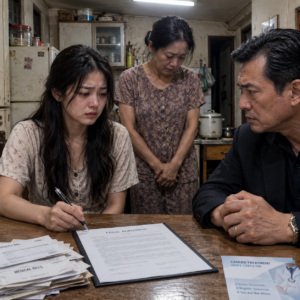
She woke 6 hours later in a posttop recovery bay with her shoulder bandaged and her abdomen wrapped tight, the kind of wrapping that meant they’d closed something significant. Her left arm was immobilized. Her mouth tasted like anesthesia and regret. On the bedside table sat a cracked Navy mug and a termination letter.
The paper still warm from the printer. The mug she recognized immediately, ceramic navy blue, a coffee cup from her unit in Tigrate that someone had given her 12 years ago. The letter was from Dr. Harrove, signed by the hospital administrator, stamped with the official seal of Mercy General Hospital. Her badge sat next to the mug, the plastic already deactivated, useless.
Her locker had been emptied. Everything was gone except the box. A cardboard box sitting on the floor beside her hospital bed, stuffed with her possessions like someone was clearing out a crime scene. The cracked Navy mug, a dying succulent she’d kept on the breakroom window sill for 3 weeks, the one nobody else seemed to notice.
And a photograph in a plastic sleeve, edges worn soft from handling. Eight faces outside a compound in Tickrret 2015. a younger self in the center, rifle slung, uniform covered in dust, eyes that looked older than her face could actually be. Three of those eight faces were not breathing anymore. One had been her best friend.
One had been a kid from Oklahoma who’d written letters home to his daughter between operations. One had been lying beside her when the IED detonated. By dawn, Katie stood at a rain soaked bus stop on Victory Drive, holding that cardboard box against her bandaged abdomen. her shoulder still screaming with each breath, water dripping from her hair and running down her face in lines that could have been tears or just could have been rain.
Savannah was waking up around her. Cars passed. Traffic lights cycled. A jogger ran by with earbuds in completely unaware that he’d just pass someone who’d stepped in front of a knife to save a stranger’s life. Someone who’d held compression on a bleeding seal for 40 minutes under enemy fire.
someone who’d volunteered to leave everything behind because the nightmares had gotten loud enough to drown out the reason she’d survived in the first place. She’d left the Navy to escape the ghosts. She’d chosen complete anonymity, told no one, not her sister, not her family, not a single person who’d known her before, where she’d gone, or who she’d been.
She changed her name in her head, kept her rank in a locked box somewhere in her chest, and tried to just be a person. just a nurse. Just someone helping in small ways in a city where no one knew she’d ever been anything bigger. Now she had nothing again. A cardboard box, a cracked mug, a photograph of ghosts, and 5 hours until something would arrive that would change whether any of this mattered at all.
But Katie didn’t know that yet. She just stood in the rain at a bus stop in Savannah, Georgia at 6:06 a.m. on a Thursday, holding everything she had left in the world and waited for a bus that would take her somewhere that didn’t exist yet. Exactly 5 hours after the knife went into her shoulder, then her abdomen, Katie Rodriguez sat in a mold plastic chair in the Mercy General Emergency Department waiting area, holding discharge papers that felt heavier than body armor.
The fluorescent lights hummed their mechanical song overhead. Her left arm was strapped tight against her ribs, the bandages underneath her hospital gown, pulling with every breath. Pain was information. That’s what they taught you in combat medicine. The pain told her the sutures were holding. The bleeding had stopped. The infection risk was manageable.
It told her she was alive. She’d been awake for exactly 17 minutes since surgery. The morphine was wearing off. That was good. She needed to think clearly about the bus she was about to catch. The city she didn’t know yet. The job she’d never take again. The cardboard box sat on the chair beside her.
Her entire life compressed into 12 by 16 in. The cracked navy mug. The dying succulent. The photo of eight faces from Tickrret. Three of them no longer breathing air. That’s when she heard them. Boots. Not the rubber sold shoes of hospital staff. Not the sneakers of visitors. These were military issue.
Polished black leather striking tile in perfect synchronized rhythm. One set of footsteps became two became a dozen became dozens. The sound building like distant artillery getting closer. The waiting area went rigid. A woman with a magazine lowered it slowly. A man holding a coffee cup went completely still. Katie didn’t look up.
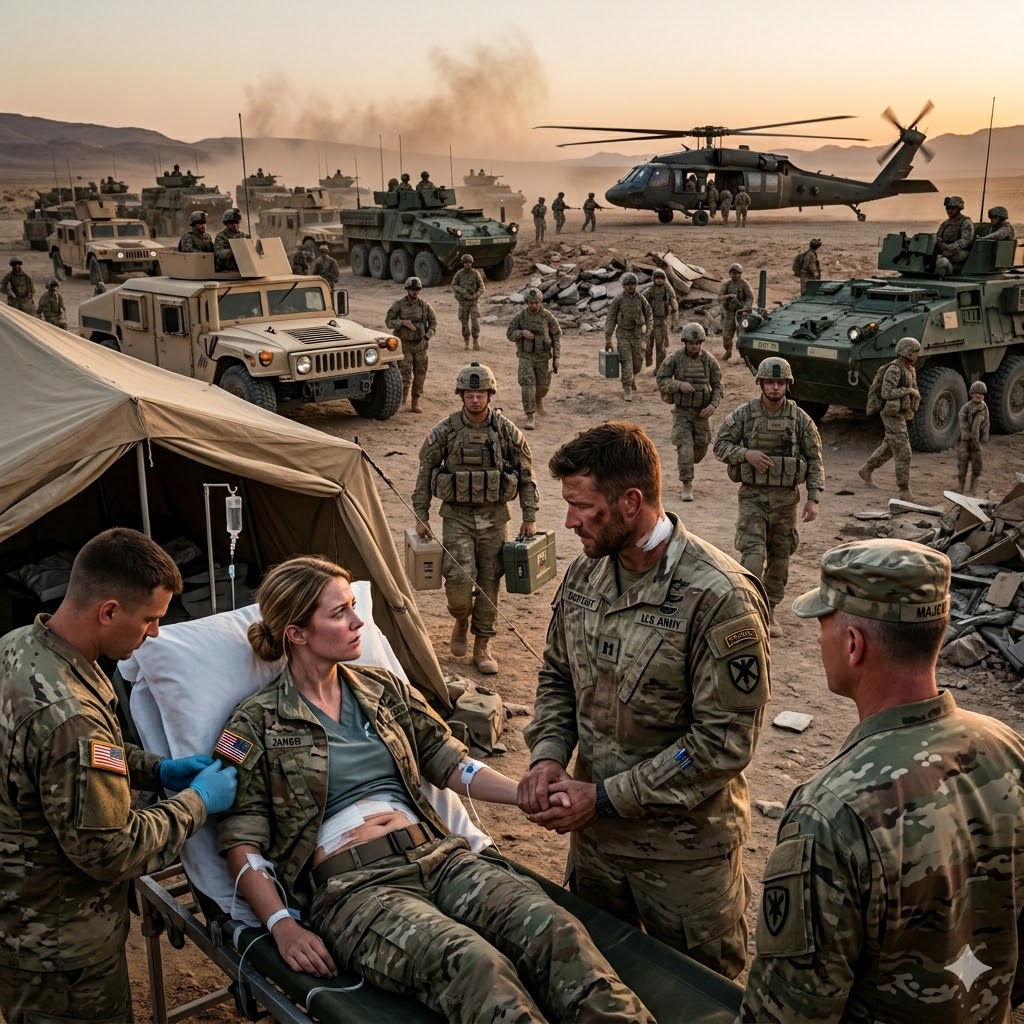
She knew what that sound meant. She’d heard it a thousand times. She just didn’t know why it was here. The doors to Mercy General’s main lobby burst open with the kind of precision that only comes from training. An entire platoon, 37 soldiers in dress uniforms, pressed and sharp as knives, moved through the entrance in formation.
Their boots struck the tile in unison. 1 2 3 4. The sound echoed off the hospital walls like thunder in a canyon. At their front walked a colonel with three silver eagles on his shoulders, his jaw set like granite, his eyes moving through the lobby with the methodical precision of someone conducting a tactical assessment.
Beside him, a rear admiral in navy dress whites, her shoulders squared, her presence making the air pressure change in the room. Katie knew that rear admiral. 34 months ago in a briefing tent at Camp Leanne, that woman had read Katie’s service record and said, “You have permission to disappear, senior chief.
When you’re ready to come back, we’ll be waiting.” Katie had never expected to take her up on it. She’d expected to vanish completely. The admiral’s eyes scanned a waiting area, searching for something or someone. In the ICU on the fifth floor, Captain Marcus Chen woke with a kind of clarity that only comes after a second brush with death.
His breathing came steady now. The ventilator no longer necessary. The tension pneumothorax was resolved. His O2 sat was 96%. He’d been sedated for 18 hours, and when they’d cleaned him up an hour ago, they’d returned his personal effects, wallet, watch, the jacket he’d been wearing when he arrived at his sister’s house for what was supposed to be a normal Thanksgiving visit.
He’d asked for the jacket. His hands weren’t quite steady when he took it, but the muscle memory was there. The hidden seam on the inside, the patch his team had sewn after Tickrret, a faded JSOC unit insignia with call sign stitched underneath in black thread. Steady, Profit, Rook, Breaker, Ghost, and three others that had no call signs anymore, just dates beside their names.
But there was something else. a notation his team had added after that operation, something he’d forgotten was there to steady. She carried us home. Chen’s eyes went wide. He’d been in the fog of trauma, in and out of consciousness, but when he’d locked eyes with that nurse during the emergency procedure, he’d seen something in her hands.
The way they moved, the precision, the absolute lack of hesitation. The same hands that had held him together in Falluja while insurgent rounds tore through the building they were pinned in. The same hands that had packed his buddy Royce’s abdomen with gores to stop the internal bleeding. The same hands that had gotten all seven of them out alive.
He picked up his phone with one working arm. The other was immobilized for the shoulder wound and called down to the ER. His voice came out from intubation, but the words were clear. Find her. The nurse with the tattoo on her left forearm. The one who saved me. I need her to know something. The waiting area in the lobby transformed.
The admiral was moving toward Katie’s chair now, and the colonel was positioning his platoon in a wide formation that turned the entire waiting area into a stage. News cameras appeared. Katie’s eyes snapped up. She recognized the logo on the nearest camera van. local Savannah news. These were not coincidences.
These were premeditated arrivals. The colonel stepped forward. His voice carried the kind of authority that didn’t require volume, just absolute clarity. Senior Chief Petty Officer Katie Rodriguez, he said, and the lobby went absolutely silent. You received the Navy Cross for actions in Tickrret. You received two purple hearts.
You received the bronze star with Veiler. You are a decorated war hero. Each statement landed like a hammer blow. The waiting area had filled with staff now and nurses from the floor. Orderly, a doctor or two drawn by the commotion. Katie sat motionless in her plastic chair, her discharge papers clutched in one hand, her right hand instinctively touching the bandages under her hospital gown.
The rear admiral stepped up beside the colonel. Her voice was quieter, but it carried farther. She saved Captain Chen’s life twice now. Once in Iraq, while critically wounded herself, once here just hours ago by taking a blade meant for him. The admiral paused and her eyes locked directly on Katie. We’ve kept her secret for 8 years because that’s what warriors choose when they want to heal.
But secrets end when heroes are attacked for being heroes. That’s when Dr. A Harrove emerged from his office. He’d heard the commotion. He’d assumed it was security removing some unruly patients family member. He pushed through the crowd with his typical arrogance, his white coat fluttering around him, his expression fixed in that smirk that had intimidated staff for 15 years.
He opened his mouth to demand an explanation from whatever administrator was apparently allowing this circus. Then he saw the security footage playing on every waiting area monitor. The hospital CEO appeared beside him, tablet in hand, her expression cold enough to freeze blood. On the screens, Katie performing the needle decomp
ression at 11:53 p.m. Her hands moving with perfect technique. The 14 gauge needle sliding between Chen’s ribs at the second intercostal space, mid-clavicular line, the hiss of air escaping from the pneumothorax. The O2 saturation climbing immediately 68 75 82 88 92 96%. And Dr. Harrove in the corner of the frame, still on his phone, still not moving.
Harru’s face went from smug to confused to white in the span of 3 seconds. The board chairman emerged from the administrative corridor. He wore a Marine Corps ring on his left hand, vintage Quantico, from the late 1980s. His eyes found Harrove like a thermal scope finding heat. When he spoke, his voice was measured and precise, the kind of calm that precedes something terrible. Dr.
Harrove, you suspended a decorated war hero for saving a patients life using the exact combat medical skills that earned her the Navy Cross. The chairman paused, letting that statement settle. You called board members to fabricate a narrative of protocol violations. You did this while knowing nothing about who this woman is or what she survived.
Harrove’s mouth opened. His voice came out shaking. She violated protocol. I have board connections. I am the board. The chairman cut him off. And I’m a marine. We don’t fire heroes. He nodded to the CEO. Show him out. Security moved forward. Harrove stepped backward. his hands rising in protest. This is insane. You have no authority.
The CEO held up her tablet again. Richard, these are eight formal complaints filed against you over 15 years. All of them buried. Three settlements paid quietly to staff members who left. She scrolled. Katie Rodriguez isn’t your victim. She’s just the one who didn’t break. One of the two board members Harrove had called this morning stepped forward, her face flushed with shame.
Richard, I had no idea what you’d actually done. If I’d known she was military. I don’t care what her background is. Another voice interrupted. One of the ICU nurses standing in a cluster of staff near the pharmacy window. He’s been doing this for years, bullying people, taking credit for our work.
Katie was just the first one strong enough not to quit. The camera lights intensified. Harrove looked around the lobby like a man watching his entire world collapse in real time. Staff he’d intimidated for 15 years stood watching him. Patients in waiting chairs stared. The local news cameras captured everything. The moment his authority evaporated.
The moment his carefully constructed hierarchy shattered against the truth. The colonel’s voice came again. Cutting through Harrove stammering attempts at self-defense, Captain Jen is alive because of her twice. You’re fired. The board chairman nodded to the security guards positioned at Harrove’s elbows badge credentials now.
Harrove’s mouth opened and closed silently as two security officers took his arms, not roughly, but with the absolute clarity that this was not a negotiation. They walked him toward the exit. His white coat swung like a flag of surrender. The entire lobby watched in silence, so complete you could hear the rain outside, hammering the parking lot like applause for something finally ending.
Katie sat motionless in her plastic chair, her discharge papers falling to the tile floor. The rear admiral approached slowly, her movements respectful, almost ceremonial. She came to attention, actual military attention, the position of honor. directly in front of the woman in the hospital gown with a bandaged shoulder and the expression of someone watching a dream become reality.
“Permission to offer you a ride, senior chief?” the admiral asked. Katie couldn’t speak. She’d spent 8 years being invisible, safe, unknown. She’d chosen the quiet life, the anonymous healing, the disappearance into the world of ordinary people. And in 5 hours, from the moment the knife went into the moment the military stepped through those doors, all of that silence had been burned away in the name of honor. She nodded once.
That was all she could do. The admiral extended her hand, and Katie took it. As she stood slowly, carefully with her left arm strapped against her ribs, she caught sight of her reflection in one of the waiting area windows. Same face, same person. But something had shifted. The invisibility was gone. The secret was out.
The woman in the hospital gown was no longer just a nurse. She was Senior Chief Petty Officer Katie Rodriguez, and the world finally knew her name. The platoon formed up around her with the kind of precision that only comes from training. The news cameras captured every moment. the military escort, the decorated war hero in a hospital gown, the moment when being invisible became impossible.
As they moved toward the exit, toward whatever came next, Katie took one last look at the place where she’d chosen to heal in silence. The ER doors opened, rain hammered down outside, and steam rose from the hot asphalt. The rear admiral held out a coat, dark navy blue, still holding the shape of the shoulders of someone who’d worn it with pride.
Katie put it on with her right arm, letting the coat settle over her wounded left side like armor. “Welcome home, senior chief,” the admiral said quietly. Katie looked at her, and for the first time since surgery, she smiled. “Not the small, controlled smile of a woman hiding. Not the practiced patience of someone accepting humiliation, a real smile, the smile of someone who’d finally been seen.” Thank you.
Um, she said, “I was starting to think I’d never be found.” Thank you so much for watching this story. If Katie’s courage moved you, if you’ve ever been underestimated and had to prove your worth in silence, please hit that subscribe button and turn on notifications. Comment below and tell me, have you ever judged someone only to find out you were dead wrong? Your comments inspire these stories.
Share this with someone who needs to remember that heroes walk among us. Sometimes in scrub saving lives in the dark.
Disclaimer : This content may be created by AI for entertainment purposes. Any resemblance to real persons, events, or places is coincidental.